Originally published at Geese Magazine.
“Those protests were the signal of a political awakening after years of relative apathy. However, the refusal of those horizontalist movements to engage with the political institutions limited their impact. And without any form of articulation with institutional politics, they soon began to lose their dynamics. Although such protest movements have certainly played a role in the transformation of political consciousness, it is only when they have been followed by structured political movements, ready to engage with political institutions, that significant results have been achieved.”
Chantal Mouffe, For a Left Populism (2018)
I’ve previously argued that the missing revolution of our lifetime, the mass protest era that slowly rolled in and was heightened with Occupy and the Arab Spring, which saw the biggest mass demonstrations in world history, ultimately failed to develop into social revolution. It was a return to political struggle in vast parts of the world that had gone dormant in the aftermath of the overthrow and collapse of the Soviet Bloc, which was ultimately insufficient to overthrow the existing capitalist governments. The 21st century has seen extreme clashes of different social classes, political vacuums explode, and a rise of radicalism on both the Left and Right. But how much have we progressed? In an age of mass political struggle, where is the wave of socialist revolutions that came in the first part of the 20th century?
The previous article was an examination of the horizontalist vs. traditional communist party model and, coupled with the analysis from the recent work of Vincent Bevin’s If We Burn, it is clear that the dominant mode of struggle for most of the 21st century, horizontalism, is a failure. It can not, as a strategy and organizational model, significantly intervene in the political vacuums that developed and, in most cases, ended up giving ground to the far right. At the time, I came down on the line that a return and a revival of the communist party model is vital to handle these political vacuums and meaningfully intervene. But was I wrong? Is the wind blowing another direction that will knock us, communists, off course?
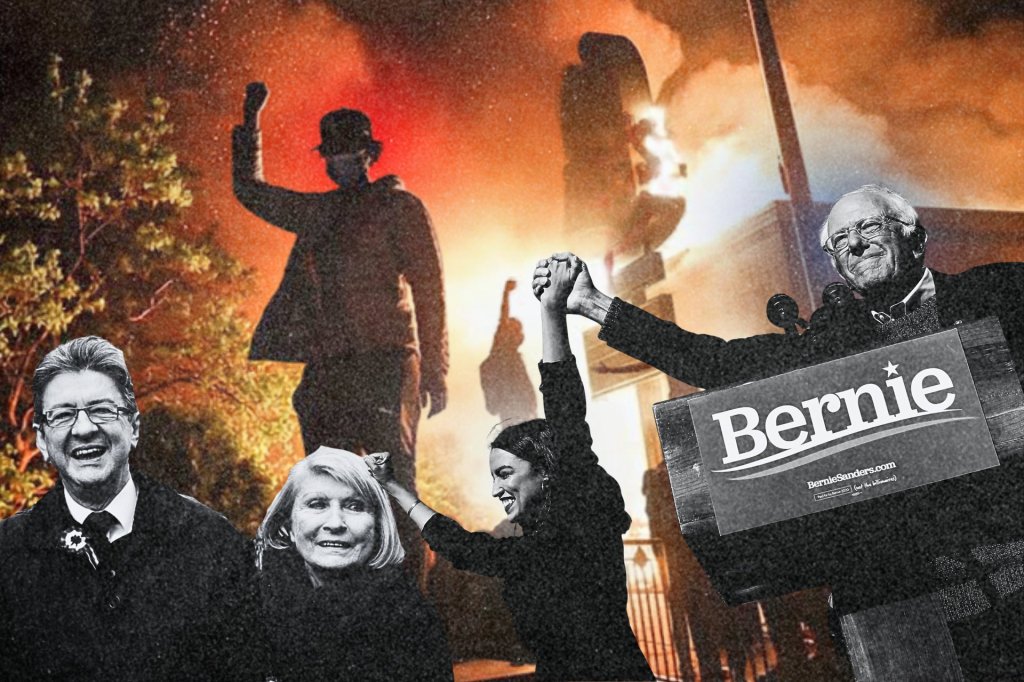
There’s another side to this story, one I’ve been neglecting in my analysis that needs to be developed in order to assess what is to be done in the current epoch. The Populist Moment, or the rise of Left (and Right) Populism, is a social development that occurred both as a co-constituent of the mass protest era and as a reaction to it. The rise of Bernie Sanders and DSA, Jeremy Corbyn and Labour, Podemos in Spain, Syriza in Greece, MORENA in Mexico, and other cases all point to this phenomenon of ‘Left Populism.’ Debate around the role of DSA, AOC 2028, and the Geese proposal for a ‘Socialist Project 2029’ all signify this phenomenon isn’t over, and the ideological and strategic debate is just as important today as it was in 2016.
Before we analyze the practical and theoretical merits of DSA today as the primary driving force for socialist organizing or the strategy behind AOC 2028, we need to analyze the merits of the theory of populism: is it capable of aggregating demands around systemic issues to develop revolutionary potential in the left political subject as it claims, or, most importantly, is it just another failed theory of social change?
Chantal Mouffe’s For a Left Populism is the perfect summation of the strengths and weaknesses of populist theory. However, while Mouffe’s left populism offers a compelling diagnosis of “post-democracy,” it falls short as a strategy for socialist transformation on its own. Its Eurocentrism, reformism, and organizational vagueness render it theoretically abstract and eclectic unless corrected by a material analysis to concretize the theory. With this context in mind, it is vital to ask ourselves: is a left populist ‘strategy’ the solution to the missing revolution of the 21st century?
Or is it just a way of managing the decline of liberal democracy, humanizing capitalism while it continues to reproduce inequality and ecological destruction? If this is the case, then surely left populism is not an answer to the missing revolution. It is a way of making peace with its absence. But what does a Marxist analysis reveal? We must tackle the subject of left populism as derived by Mouffe and, in a future article, detail the application of that theory with a communist lens from Geese, and decide whether it is the key to solving the revolutionary riddle of our lifetime.
Left Populism and the Chain of Equivalence
“In his book On Populist Reason, Laclau defines populism as a discursive strategy of constructing a political frontier dividing society into two camps and calling for the mobilization of the ‘underdog’ against ‘those in power.’ It is not an ideology and cannot be attributed a specific programmatic content. Nor is it a political regime. It is a way of doing politics that can take various ideological forms according to both time and place, and is compatible with a variety of institutional frameworks.”
Chantal Mouffe
Ernesto Laclau and Chantal Mouffe were the preeminent thinkers regarding populism for the better part of the last four decades. And in their aforementioned definition of their theory, we see an encapsulated ‘populism.’ From the outset, we have a radical theory with significant (and perhaps intentional) gaps. It calls for a “discursive strategy” that will “construct” this new “political frontier” which will split society and mobilize it into “two [opposing] camps.” But it specifically rejects the analogy to a “regime” or political program with a predetermined content. It is specifically ideologically ambiguous or amorphous.
Mouffe continues: the “populist moment” happens when the “pressure of political or socioeconomic transformation” undermines the dominant social hegemony by the “multiplication of unsatisfied demands.” As the hegemonic order loses its support and becomes “disarticulated,” a political vacuum develops where a new rising hegemonic social subject, “the people,” can reconfigure the “social order.” It is easy to see how this applies to the 21st century.
We’ve seen the neoliberal hegemonic order decline. What united Thatcherism, Reaganism, and the Democratic Party establishment from Jimmy Carter on was this neoliberal foundation, as elaborated by Marxist academic David Harvey. But that sociopolitical hegemony in the last decade has decayed beyond repair. It’s declining; it’s being destroyed, in the process of shattering into a million pieces. The mass protests and rise of horizontalist approaches, the return to more traditional socialist formations, and this clear sign of a rising but not-yet hegemonic Left Populism are all a reaction to the dying hegemony of neoliberalism–along with, of course, the embrace of extreme nationalism and populism on the right. As Mouffe details, when a hegemony is crumbling, we enter a populist moment when the disparate social struggles can be congealed around a new rising hegemonic force. She writes:
“I would like to emphasize that a ‘chain of equivalence’ is not a simple coalition of existing political subjects. Nor are we dealing with a situation in which an already constituted people confronts a preexisting adversary. The people and the political frontier that defines its adversary are constructed through political struggle, and they are always susceptible to rearticulation through counter-hegemonic interventions. The democratic demands that a left populist strategy seeks to articulate are heterogeneous and this is why they need to be articulated in a chain of equivalence.”
Mouffe is claiming that through political struggle, diverse groups can, by commonality and differences, become articulated around broad social “signifiers” such as freedom, democracy, the people, etc. The observation that political struggle is what constructs the political frontier and is in constant flux is salient, but leaves out the role of how political frontiers set the initial parameters of that struggle. The social rearticulation through struggle has a certain material foundation that’s relative depending on time and location. But how do we engage in that struggle? How do we organize ourselves for that effort? If Left Populism can’t be “programmatic content,” is it just reduced to the spontaneity of the social ruptures and whims of the contending classes? How can a discursive strategy be implemented by political and social organizations? Mouffe doesn’t contend with these issues; they’re left in the abstract.
This is not to say that populist theory is theoretically unfounded, but that populist theory taken in the abstract without concretization will lead to tactical and strategic mistakes. This is not a unique phenomenon with social theories. Marxism and communism, when taken in the abstract, become distorted and vulgar. All political theories of social change are Schrödinger’s Cat. We only know if it’s alive when it interacts with the real world. And in For a Left Populism, it largely remains in the abstract except for an analysis of how neoliberalism’s hegemony formed in the UK.
Mouffe is correct in observing that mass protests can only achieve a certain role “in the transformation of political consciousness” but can achieve “significant results” with a “structured political movement.” But Mouffe tends to universalize this specific historical phenomenon within the text regardless of relative material conditions, and the critique of the Old Left binary of “reducing politics to the contradiction of capital/labour” that permeates her work is potentially repeated with the priority on the “two camps” clashing for social hegemony that is central to the populist conception of social change. It is stressed in other texts such as On Populist Reason and Hegemony and Socialist Strategy that an understanding and application of particular historical and material circumstances is imperative in the populist moment, but if organizers only engage with For Left Populism, that doesn’t come across, and the vagueness in this text can be misconstrued by people in DSA or other organizations.
For Mouffe, the left populist strategy operates through two key mechanisms. First, the ‘construction of a political frontier’: a discursive division between the ‘people’ and the ‘oligarchy’ that reconfigures how society understands itself. Second, the ‘chain of equivalence’: the articulation of diverse democratic demands (economic, ecological, racial, gendered) into a unified political subject without reducing them to a single ‘class essence’ as traditionally conceived by Marxists. This articulation is the heart of the strategy: it is how heterogeneous struggles become a collective will without losing their specificity, at least in theory.
Mouffe’s rejection of what she calls “class essentialism” has merit; people’s struggle can’t be simply reduced to labor struggle. The point is to connect class struggle with anti-colonial, ecological, and other social struggles. We can’t fall into class reductionist arguments; however, Mouffe’s refusal to make a revolutionary break with the “liberal-democratic regime” is to ignore not only the class question, but also the colonial question for colonized peoples.
This is where the book is most limited. As an analysis of psychological developments of masses of people in political ruptures, Mouffe’s analysis is excellent. As a guide to organizing, its abstraction leads to a struggle in practical implementation. Sociopolitical relations are vastly complex, and fundamentally can’t be reduced to binaries for political programs and policies. This is a fact the Old Left begrudgingly had to admit over decades of struggle. The binary of worker and boss is a social reduction, especially when accounting for social questions such as race, (settler) colonialism, imperialism, patriarchy, etc. The mosaic of society has to be accounted for before, during, and after the revolution. Mouffe wants to eliminate that capital/labor binary, for the expressed purpose of the mosaic of society’s many struggles—but she then says the populist movement inevitably creates its own social binary. Mouffe, of course, says that the social revolution can’t ignore that varied social dynamic, but the creation and development of social binaries, of us vs them, has negative elements that seem quite obvious.
The “Liberal-Democratic Regime” and the Colonial Question
“What is urgently needed is a left populist strategy aimed at the construction of a ‘people’, combining the variety of democratic resistances against post-democracy in order to establish a more democratic hegemonic formation. This will necessitate a far-reaching transformation of the existing relations of power and the creation of new democratic practices, but I contend that it does not require a ‘revolutionary’ break with the liberal-democratic regime.”
Chantal Mouffe
Mouffe is so close yet so far. In times of hegemonic disarticulation, what defines the “people” vs “the ruling class” is up for grabs. Crisis allows the broad forces of the working class and oppressed people to unify around new organizational structures, superstructural elements, and ideological developments towards a new liberatory hegemony. But that entire process—the formation of a ‘people,’ so to speak–-occurs in the historically specific period of the populist era of the 21st century as something against the far-right reactionary forces in the vacuum of neoliberalism. Reclaiming ‘liberalism’ in the fight to expand and transform democracy is counterintuitive to the material reality that neoliberalism, as David Harvey argues:
“…is in the first instance a theory of political economic practices that proposes that human well-being can best be advanced by liberating individual entrepreneurial freedoms and skills within an institutional framework characterized by strong private property rights, free markets, and free trade. The role of the state is to create and preserve an institutional framework appropriate to such practices. The state has to guarantee, for example, the quality and integrity of money. It must also set up those military, defence, police, and legal structures and functions required to secure private property rights and to guarantee, by force if need be, the proper functioning of markets. Furthermore, if markets do not exist (in areas such as land, water, education, health care, social security, or environmental pollution) then they must be created, by state action if necessary. But beyond these tasks the state should not venture. State interventions in markets (once created) must be kept to a bare minimum because, according to the theory, the state cannot possibly possess enough information to second-guess market signals (prices) and because powerful interest groups will inevitably distort and bias state interventions (particularly in democracies) for their own benefit.”
A Brief History of Neoliberalism (2005)
Harvey adds that “accumulation of dispossession” is the main mechanism for neoliberal surplus creation and redistribution, and it’s analogous to what Karl Marx called “primitive accumulation.” So, the ideological and socioeconomic mechanism for neoliberalism’s hegemonic rise is remnant to the rise of capital that was co-constituent of the mass expansion of European (settler) colonialism that Marx referred to in Capital Vol. 1. In it, Marx writes:
“The discovery of gold and silver in America, the extirpation, enslavement and entombment in mines of the aboriginal population, the beginning of the conquest and looting of the East Indies, the turning of Africa into a warren for the commercial hunting of black-skins, signalised the rosy dawn of the era of capitalist production. These idyllic proceedings are the chief momenta of primitive accumulation. On their heels treads the commercial war of the European nations, with the globe for a theatre.”
Mouffe attempts to distinguish between ‘political liberalism’ and ‘economic liberalism,’ arguing we can radicalize the former and transcend the latter. But Harvey’s (and Marx’s) analysis shows this distinction is unsustainable. Liberalism and neoliberalism are not a neutral or unique economic overlay over neutral political terrain. They are both an ideology and political-economic system with specific historical contexts built on extreme globalized violence, and they are deeply interconnected.
Mouffe mistakes the ideological and socioeconomic system that created 400 years of global colonial genocide as something that can be reclaimed, and also doesn’t make the systematic connection between the ‘liberal-democratic’ orders that have led to more mass slaughter and oppression than any other period of human history. The neoliberal shock therapy on the world “claimed nearly 17 million lives” in Eastern Europe alone. In the Western Hemisphere in particular, 90% of the Indigenous population was killed due to colonialism. Mouffe’s error is in emphasizing the priority of the concept of liberalism over its historical substance.
In the US, where we are undeniably in the eye of the populist storm, we have to ground that analysis in the settler colonial dynamics that still permeate our society. If left populists hope to navigate the waters of the new contending hegemonic forces, a strong analysis of the colonial question will show that a reclamation of radical democracy can only happen with a complete negation and transcendence of the liberal social order—the same order that has forced Indigenous people from their land, repressed and exploited them, and committed genocide against them in the name of liberalism..
How can we construct a “people” to contend with the ruling class when, in a settler society, class collaborationism is a key characteristic? An important issue facing us in the populist moment is the need to coalesce forces into a true liberatory movement that will fight for political hegemony. But if class collaborationism is central to what constitutes American hegemony, we have to contend with that contradiction as it relates to left populism. If there are material and social dynamics that create a tendency for class collaborationism broadly, then that issue is also pertinent for the left, which doesn’t exist outside of society–but is embedded in it. In American history, the construction of the “people” has consistently failed to include the Indigenous peoples, the Black community, and other oppressed groups. A true radical transformation of democracy and society in colonized places will have to abolish what we know as liberalism and neoliberalism. The new “people” will have to include and center Indigenous and oppressed communities in a way that the Left and the settler working class broadly haven’t done in our history. It has to directly challenge class collaborationism if we hope to win.
Mouffe remarks in the book that we should use the right populist playbook of the people vs the enemy, but how do we disarticulate centuries of social priming that the “enemy” is the scary Indigenous, Black, and Brown person on the perpetual frontier? This social priming is so intensely strong that it made people commit the worst atrocities in human history for centuries; atrocities which are still carried on to this day. Social violence in the US disproportionately affects those communities and nations that were and are adversely affected by settler colonialism and imperialism.
Indigeneity “is a fluid, relational, and inevitably political identity” that is a “power dynamic that is highly contingent, informed by a certain historical consciousness and entangled— always— with gendered and racial identities brought through colonization.” The Indigenous identity and social relation “always refer to a colonial experience in one form or another; there is a “we” and a “they” to the formulation, and one party in this tight relationship arrived uninvited.” So in a settler colonial society like the US, this social binary has overlaid the entire capitalist system with the colonial dynamic and power relation. If we are to construct a new “people” vs “the ruling class,” we have to understand not only the complex social fabric with which to weave that development in the populist era, but the power relation that has set a unique colonial binary that must be addressed on its own terms: a binary created by liberalism and perpetuated by neoliberalism that we have to dismantle to achieve a new radically democratic society.
Settler colonialism isn’t “a discrete, self-contained structure of domination, but one that interacts with– and is co-constituent of– key processes of domination that continue to define the present moment, both in and beyond settler colonial regimes. Capitalism, racism and dispossession, as well as different forms of state violence and gender oppression, emerged within, through and/or in relation to settler colonial expansion and domination.” So, if we are to navigate correctly through a populist moment or rupture in the US to actively progress society past the point of capitalist domination, we need to address the colonial question directly. The dismantling of liberal hegemony has to also dismantle the colonial power relations that give “white” and “Indigenous” their connotations as signifiers.
Mouffe claims that a “total rupture” with liberalism to create a “new political community, from scratch” is not necessary. The only aspect of that that is true here is the “from scratch” element. The total rupture with the liberal-democratic order will, by necessity, to succeed long-term, have to transcend liberalism into a “new political community,” and it will develop due to particular historical and geographic limitations. How we in the US establish the new political order will naturally have to develop out of our material history and conditions, which will include and have to center Indigenous and Black Liberation. So our “from scratch” is that history of liberation struggle, not liberalism’s political traditions.
We see this proven by the public discourse in recent decades in post-revolutionary Cuba around the racial (colonial) question. Afro-Cuban revolutionary and theorist Esteban Morales Domínguez details at great length in his book Race in Cuba that the capital/labor struggle is a limited one, that even a workers’ revolution and a new sociopolitical system can’t automatically address every significant social contradiction. He writes:
“It was idealistic to think that solely on the basis of distributing equality and the great humanitarian work of the Revolution that the racial problem would be settled. It was inevitable that we would have to pay a high price for the social imbalances generated by the crisis.” He rightly critiques the dogmatic Marxism-Leninism that “introduced models of social and cultural realities that had hardly anything to do, and sometimes absolutely nothing to do, with the reality of the country. In Marxist discourse, the mestizo and black problem was submerged in the general questions of class, diluting it further within the general problems of poverty and marginality. And thus society refused to accept that blacks and mestizos had inherited a particular legacy from colonialism and neocolonialism, a mark much more difficult to overcome.”
Race in Cuba (2012)
Mouffe can’t really commit to a strong break with capitalism in For a Left Populism. She accepts that the “capitalist order…remains within the liberal-democratic framework.” But she attempts to strip away the “economic liberalism” from “political liberalism” in a conception of “radical reformism” that would reclaim what she sees as the best parts of liberal-democratic order.
This leads her to make claims that evince her attitude towards communism rather than follow logically from her analysis. She argues, for example, that “anti-capitalist struggles” are going to be present in the Left Populist movement or moment. Still, she maintains a noble savage view of “the people” that conceives them as being unable to even “perceive” anti-capitalist struggles. She claims that people don’t struggle against capitalism “as an abstract entity,” but the entire Populist theory she provides is an understanding of how social abstracts can be re-articulated in political ruptures of social hegemony–how abstract entities acquire political salience in practice–so why couldn’t “the people,” with the right political organization, concrete conditions, and discursive strategy, absolutely “perceive” that “the oligarchs” are the capitalist order? Or, to extend it, that liberalism is the ideological basis of capitalism and “the people’s” antagonist? If, even under a socialist framework, colonial and racial legacies can be existential contradictions, we need more than discursive strategy in the eye of the populist storm. We need a total institutional, cultural, and material transformation of society. A populist moment can only speak to the rupture preceding that necessary transformation–but it is a mistake to treat it as the content of the transformation itself.
Left Populism is Here, What Next?
The limitations of Mouffe’s populist theory without a material intervention are evident, as we are still in the left populist moment and have been unable to transcend it, yet. But the book remains important and ultimately clear-sighted: Mouffe is right about the decline of the neoliberal hegemony, the rapid disarticulation of societal norms and signifiers, and the rise of the movements on both the right and the left attempting to fill that political vacuum and transcend the populist terrain. We’ve seen rolling social ruptures where the balance of class and social forces shifts and moves. But the attempts to reclaim liberalism are an Achilles’ Heel of Mouffe’s theory, and in order to use the theory of populism to transcend our social order, we need to work our way through that contradiction.
Political ruptures are the sword of Damocles. When the social order is in flux, it’s often violent. Danger lurks around every corner, but so do opportunities for every political faction to grab the hegemonic throne. We can’t let our anxiety about that political struggle stop us. We can’t get to the political rupture–and get scared of the revolutionary moment and seizing power.
The social faction that is the best organized, equipped, led, with a clear plan of action, will often win that violent clash. Mouffe is correct that this moment is an opportunity to exponentially increase “the people’s” side of this existential struggle. Who are our allies? Who are our enemies? Those answers from yesterday will change by tomorrow, and they have to in order for us to win. A democratic revolution that doesn’t factor in the colonial question, landback, and liberation for oppressed peoples will be hamstrung. We will be fighting with one hand tied behind our backs–for what? When we talk about the transformation of liberal society into a new political community, something Mouffe says we don’t need to do, that will have to include epistemologies that didn’t develop the capitalistic, exploitative, and oppressive systems that have led humanity to the brink of existential collapse.
I don’t deny the need for a discursive strategy, but there is a natural question upon its acceptance of its necessity: “what then?” How do we accomplish that strategy? Mouffe, of course, talking in the abstract, leaves that question up to people’s local conditions. That’s technically true, but it doesn’t resolve the need for us to attempt an organic analysis and class theory capable of navigating this moment.
We need a political vehicle to get us through the storm of populism and hegemonic realignment. In the US, I believe we are at a point where we are discussing whether that vehicle has developed in DSA, but in other places that may be in this social crisis of hegemony, they too will need more than just an amorphous movement of the people. But has DSA made a concerted effort to center and coalesce Indigenous and Black struggles to the democratic socialist struggle? In 2021, 85% of DSA was white, and with the white population of the US just under 60%, it’s clear white people are overrepresented within the organization. Also, has DSA narrowed its scope of populist struggle to purely electoral campaigns and, even within that, centered on deliverist demands such as affordability rather than restructuring power? Are these not strong reasons why the organization is still more connected with the white working class than other oppressed peoples? For example, Trump’s administration is currently building the Southern Border Wall through the Tohono O’odham nation. This is a struggle that intersects the anti-ICE and migrant struggle, Indigenous sovereignty, and ecological destruction. Where is DSA? Where is the white working class left? It is not enough for local comrades to provide their bodies or work to the cause; it is necessary for the political organization, if it seeks to be one, to turn these into political issues we organize and message around.
We tried mass spontaneous protests and leaderless movements for decades, and it fundamentally failed. We need political organization. We need mass coalition building. We need to not only engage in mass struggle, but use that mass struggle to reset the terms of struggle– the rearticulation of society to where we not only have a broad mass of “the people” but an ideologically confident and militant one. We need more than Mouffe’s “radical reformism”; we need radical revolution. We need to expand the democratic struggle and turn it into a democratic revolution capable of politically consolidating anti-capitalist, anti-colonial, anti-imperial, anti-racist, anti-patriarchal demands. We have to find a way to use every institutional and cultural power we have to expand and radically transform the struggle.
The political vehicle we need to get us through the populist moment successfully to wage the next phase of social struggle must be democratic enough to absorb the eclectic energy of the populist moment, but disciplined and centralized enough to maintain strategic coherence. It would need to engage in electoral politics full-throatedly at this critical conjuncture without falling into a toothless “radical reformism.” It would need to build cadre within “the people” capable of exercising critical moments of leadership during the rupture, and it would need to center the colonial question in the US context, not as an add-on, but as a constitutive element of the struggle. The sects failed because of their rigidity and isolation from the masses; the horizontalists failed because they had zero capacity for a strategic and critical political intervention. The challenge is to build an organizational front that can absorb, consolidate, and mobilize the eclecticism of the American Left without becoming isolated from mass politics.
If mass politics is the terrain we are fighting on, then we have to embrace its implications fully in order to transform it beyond this impasse. We also have to expand and transform mass politics to give it coherence and militancy. Communists need to engage in the mass struggle fully and openly. We need to help concretize the discursive strategy to gain political power. That means an open diversity of tactics; let a thousand flowers bloom in the struggle. Mouffe rightly critiques us as being stagnant. We have to be dynamic and aware of when the social conversation shifts, is open to rearticulation, and rapidly attack those openings. The left populist movement has been weak; that is also undeniable. Even when a nominally left populist movement has gained political power, such as Syriza, or has gained significant political momentum like Podemos, they have failed. We can’t let that happen here. We have to learn from their mistakes, apply these theoretical lessons to our material conditions, and transcend the populist moment.
Mouffe attempts to wash that away with “the brutal response of the European Union,” which is true, but the external factor is only half the equation. There’s an internal factor of populism that has difficulty with radical societal transformation because a social binary is only ‘useful’ for historically and materially specific situations (such as the binary of white and Indigenous in settler colonialism). Inversely, a Left campaign to seize hegemony in a political crisis is necessarily the objective, but what happens when the crisis is over, and hegemony is won? The new society won’t be won cleanly; it will be a non-binary mosaic rife with contradictions. The strategies to deal with social ruptures are different from the strategy to maintain and further develop the new political community.
On the other hand, Mouffe’s openness in concrete application perhaps points us in the right direction. There is no need for us to justify retrospectively the failures of American communism, the sectarian left, or foreign left populism. Our job is not to copy models that work in other places, or apply strategies found in books, but to produce our own revolution while navigating the populist political terrain. We have to define our own struggle. Ultimately, the buck stops with us. Mouffe cannot understand what needs to be done in the United States, because those of us who are doing it are in the only place where that understanding can be formed.
Neoliberalism is dying. The hegemony that controlled and united the Democratic and Republican Party for nearly four decades is fading, and the rise of MAGA as the reactionary pole is attempting to fill that void. MAGA and the fascist Trump movement were the political vehicle that took over the GOP and ‘radically’ transformed it. The Democratic Party establishment has lost all political will and trust from “the people,” and we’ve seen clearly that Democratic Socialism is struggling to overtake that political corpse for its own social realignment towards a left pole. Now, quite loudly, there have been critics of this “discursive strategy” from DSA.
We need to be honest about the historical failures of the communist party model to gain mass political prominence in this epoch, even if we understand that the path of left-populism has been similarly non-linear. Non-linearity is, of course, not an immediate disqualifier, as different strategies can prove useful at different junctures, as the party model has. But is the communist party model that developed in that historically specific juncture present in the current struggle? In political struggle, you can’t just be right; you can’t just have the truth. We need to win the struggle for a social revolution to transform society. Why has the Communist Party stagnated after a brief period of growth? Why has DSA exploded in cultural impact, and are they on a path towards social revolution? If we hope to revive the communist party model, and communism broadly, into its own social pole with a winning chance for hegemony, if we hope to understand the dialectical relationship between democratic socialism and communism in the broad struggle of “the people,” then we need to analyze our specific populist moment, the role of DSA, AOC 2028, Project 2029, and whether we are nearing the missing revolution.
 Red star tribune
Leave a comment