“And the revolution itself must not by any means be regarded as a single act…, but a series of more or less powerful outbreaks rapidly alternating with periods of more or less complete calm. For that reason, the principal content of the activity of our Party organization, the focus of this activity, should be work that is both possible and essential in the period of a most powerful outbreak as well as in the period of complete calm, namely, work, of political agitation…” -Vladimir Lenin
There has been a surge of autonomous groups in organizing spaces in recent years. For those who came up in the wake of Occupy and the Indignados—in the wake of the financial crash and Arab Spring—the topic of horizontal or autonomous groups is nothing new. It was the dominant mode of radical organizing, especially for spontaneous actions, for the better part of a decade. Across the world, Greece, Spain, Brazil, Chile, the U.S., and more, all experienced significant social upheavals, often fueled by these movements throughout the first quarter of the 21st century. Frequently, they were described as spontaneous, leaderless, horizontally structured, and digitally organized.
With a new generation entering the struggle that didn’t come up in that environment—and for many engaged in anti-ICE resistance today—the topic of how to organize is and should be back in the discourse cycle. I want to examine the recent history of spontaneous, autonomous, or horizontal uprisings, and detail the theoretical and practical debate between different modes of organizing—utilizing the work If We Burn by Vincent Bevins, my own practical experience with these two modes of organizing, and the theoretical work at the foundation of this debate. “Vertical vs horizontal organization” is not a new debate. However, with each new generation that joins the struggle, it seems to come back into vogue.
Since I’ve been politically aware and active, we have seen waves of mass protests and movements around the world, with limited or backwards results. We have lived in recent decades through the biggest protest movements in world history multiple times, but without any seismic shift in the global system of capitalism. We must get to the root of this question; the answer lies in the type of organizations and movements we are building and sustaining.
21st Century: An Era of Horizontalism & Anti-Politics
Brazil’s Anarchist Movement Against Social Democracy & the Return of the Far-Right
For those who were too young or somehow weren’t paying attention at the time, in the early 2010s, the world was aflame. Mass protests and movements swept the globe in response to a variety of local and international conditions. The Arab Spring, Indignados, Occupy Wall St., and so many more were global phenomena. From 2011-2014, you could not escape some form of “revolution” happening. It was a massive and much larger echo of similar movements in the late 90s and early 2000s— Seattle and Ukraine, in particular.
With the violent overthrow and dissolution of the USSR and numerous other socialist countries, the Old Left in many places lost its social cache. The communist-style of party organization had seemingly lost the Cold War. This was the ‘end of history’ as we knew it. In the US and the West generally, this meant a further collapse of the Old Left communist parties, which were already in a state of decline. The few holdouts at the time—China, Cuba, DPRK, Vietnam, and Laos—went through difficult periods of development and change during the direct aftermath of the USSR’s fall.
Not that it tells the full picture, but the fact that we as a society went from grunge to nu-metal is a sign of the nihilism that had festered in the superstructure with the complete collapse of the “Old” and “New Left” of the 20th century. In most places, the longstanding or well-known vehicles for political engagement and change were seen as dead. The resurgence of more anarchist forms of resistance is also a byproduct of that post-Soviet period of neoliberal globalization, hyperindividualism, and the aforementioned social nihilism.
Mass protests and occupations of institutions or public spaces were not new tactics. While the New Left had a significant militant communist element, it also had a nebulous left element, like Students for a Democratic Society (SDS) or even the American Indian Movement (AIM), which had anti-communist tendencies. The Civil Rights Movement generally used mass protests and sit-ins as well. The tactics that became synonymous with Occupy or other 21st century movements were not created by them, but merely the utilization of past techniques from previous struggles.
Of course, anarchist structures, or autonomous and horizontal structures, were not new to the Left or social movements in the 2000s. There’s a long, storied history of that school of thought. Its theoretical, tactical, and strategic differences with the communist party structure will be in the next section, but it’s important to note that when talking about these movements in the last 26 years, it’s ultimately, mostly, coming from the anarchist tradition. Though not every example of this era will fit that categorization.
When referring to the Ukrainian or Hong Kong uprisings in the mid-2010s, these were not left-leaning anarchists, but they were in this continuum of the period of horizontal and “leaderless” movements. These spontaneous eruptions in respective societies can best be described as “societal explosions.” Political vacuums in Tunisia, Egypt, Turkey, Yemen, Brazil, Chile, the U.S., and many other places, in large part developed by these mass protest movements, are a crucial element to this story as well. But the reality is that political vacuums don’t truly exist. There are always groups waiting to fill that vacuum immediately.
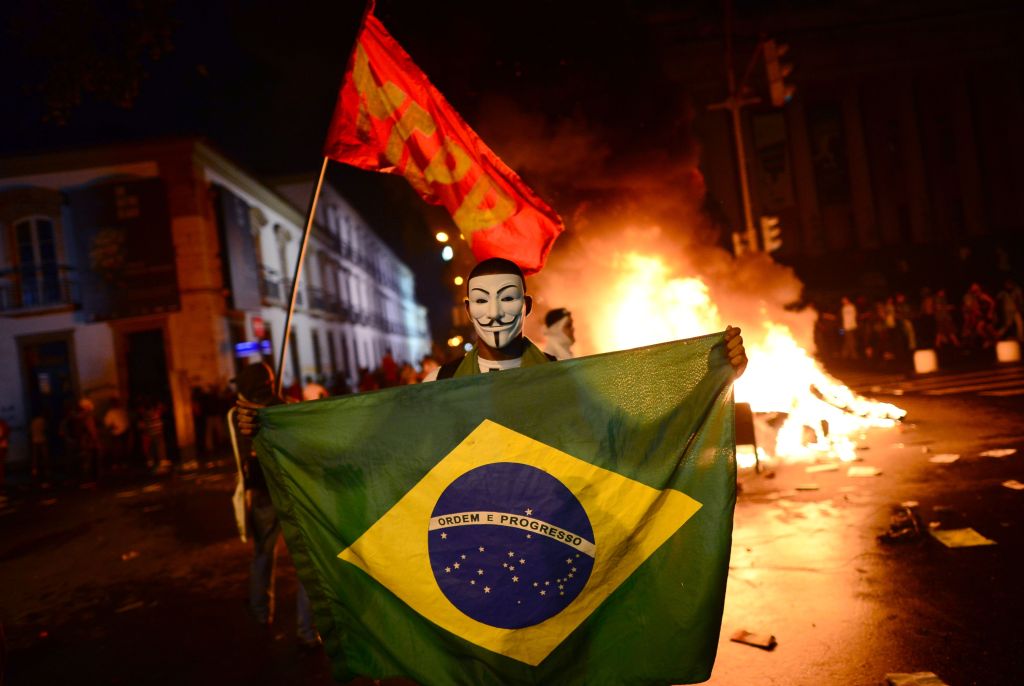
Brazil is the most intriguing example to detail and discuss. The Old Left in Brazil was not as weakened by the collapse of the USSR or the Sino-Soviet split as so many other parties had been, in large part, because it was a crucial part of the resistance to the long-standing military dictatorship throughout the 20th century.
In 1980, when the Partido dos Trabalhadores (PT/Worker’s Party) was founded as a new mass left party, the Partido Communista do Brazil (PCdoB) was a key part of that development and anti-dictatorship coalition with the PT. So when the PT rose to executive power with Luiz Inácio Lula da Silva in 2002, the PCdoB was an active part of the new center-left, progressive administration. The largely Indigenous-led Movimento Sem Terra (MST/Landless Workers’ Movement) is also a long-standing left-leaning political and social movement. And then there’s the explosive youth punk-scene reading Kropotkin and Bakunin. These factors all poured into this post-dictatorship society, where the society had not fundamentally changed, and was ready to explode.
Neoliberalism was still pushing a hyper-reactionary oligarchy that controlled the media, judiciary, and military. The new left coalition coming to political power was in a precarious position and had to produce results fast. It should be stated that from 2003 to 2016 (from Lula to successor Dilma Rousseff), 20 million people were lifted from poverty by policies they and the PT largely enacted. Raises in the minimum wage, increased investments in socialized healthcare, and higher education were all positive for the general public. But there were a few moments early in their tenure that indicated the clock was ticking.
In the year Lula was elected, a mass protest movement kicked off in the city of Salvador by the student union ”strongly linked” to the PCdoB. It was over the rising public transportation fares in the city, and it initially started with Old Left support. But as it grew bigger than the student union could control, protesters started to declare “no flags” at the demonstrations, and that this was now a movement without any party. In 2004, Lula deployed the Brazilian military along with the US and UN forces to overthrow progressive Haitian leader Jean-Bertrand Aristide in an act of imperialist regime change. And the following year at the World Social Forum, the Movimento Passe Livre (MPL/Free Fare Movement) was formed.
The MPL was initially a very small, leaderless, and horizontal group. Its founding charter stated, “a horizontal movement is a movement in which everyone is a leader, or where leaders do not exist.” It declared it would be “autonomous” and fully independent of existing political parties. All decisions would be made by consensus, not majority vote. The MPL itself was directly inspired by the neighborhood assemblies in Argentina that formed in 2001 when the state and economy collapsed, which adopted horizontalidad as well. Chile had a similar history with asambleismo.
Lula would end his two terms with an 83% approval rating and, as previously mentioned, some major reforms and policies helped the masses of Brazil. However, Lula wasn’t conducting a socialist transformation of the country. That was never in the plans for him, and especially, but more broadly, the Workers Party as well. Before he was elected, he’d already made a promise to continue the basic economic structure of the previous administration.
His successor, Dilma Rousseff, who is now the head of the New Development Bank within BRICS, was a former communist guerrilla during the era of the military dictatorship. She was imprisoned and tortured in the early 70s for her work. Rousseff won the election in 2010 and became the first, and to this point only, woman president of Brazil.
All of this is part of the “Pink Tide” that rolled through Latin America, where progressive and some outright socialist administrations came to power in Venezuela, Argentina, Bolivia, Uruguay, Chile, Ecuador, and Paraguay. The Left was the key force resisting U.S. puppets and interventions in the region for a better part of a century, and was slowly gaining real political power.
For MPL, and ultimately the future of the Brazilian people, this didn’t matter to them. An age of anti-politics became the norm. In 2011, they targeted the issue of raised bus fares. Less than 50 total members of MPL at the time managed to create a political snowball that led to Jair Bolsonaro and the far-right gaining political power in Brazil.
MPL organized protests, invasions of bus stations, mass fare evasions, and admittedly declared their movement an “a-party” movement. They would tear down any political flags that fellow protesters would bring to their actions.
In 2013, mass police repression, intense and slowly shifting media coverage, the overall global political climate, and many more seen and unseen factors led to the biggest mass protests in Brazilian history. Millions marched. Thousands brutalized by the police and caught all on camera.
But the reality of a leaderless and structureless movement started by 50 people is, who decides who’s in and who’s out? When millions are now joining you, how do you centralize messaging? How do you stay on target for what you are organizing? In a running theme of this era, the political explosion that MPL created against not a fascist military dictatorship, but a progressive, left-leaning democratic administration, gave open ground for the far-right to take control.
When leaders aren’t collectively decided upon, they will develop on their own. That’s what happened to the mass movement in Brazil; Jair Bolsonaro and his cronies co-opted even the name of the MPL (the right-wing formation that formed during that period, being the MBL) and latched onto that anti-politics that had become the norm. He was able to position himself as a political outsider and thus garner populist support. The MPL struggle that originated on the issue of bus fares became a nationwide mass protest movement over state repression. Since the state was at that time run by the Workers’ Party, and since the MPL had no inclination to develop electoral party politics, the fascists filled that vacuum.
Dilma Rousseff was impeached in 2016, Lula was imprisoned, and the 5th largest country in the world rapidly declined from the improvements under the PT government. Bolsonaro’s various far-right party allegiances and the MBL set the struggle back decades. Lula was eventually freed, and the PT is again in political power, but in a clearly more fragile domestic dynamic compared to their meteoric rise. When Lula first left office, his approval rating was 83%. Now, at 80 years old and planning to run again, is only at 34%. Bolsonaro is in police custody and facing 27 years for a coup attempt. His son most likely will be the far-right candidate for the next election after his father put nearly 10 million people into poverty.
The MPL still exists, but the original 50 or so members have all left. MST was a key coalition partner to get Lula freed and running again. But the future of Brazil is in a mist. Beyond the horizon at this point. The Workers’ Party and PCdoB have not recovered from the societal explosions in the mid-2010s, and the anarchist movement has been limited after the MPL’s difficulties
.
The Echoes of Arab Socialism from Egypt to Yemen
Egypt was a hotbed for Arab Socialism and nationalism throughout a major part of the 20th century. Gamel Nasser was a Third World icon who had retaken the Suez Canal from colonizers, established political sovereignty, and aided other anti-colonial movements—notably Yemen.
Nasserites were never too friendly with communists internally, though there was a major relaxation of internal repression against communists in the 1960s; Egypt would develop close ties to the USSR as well. The national liberation struggle carried out by Egyptians during that period was shaped by the Leninist/Communist party structure. Nasser himself initiated the creation of a Leninist-style group called the Vanguard Organization to defend the revolution.
However, in 1970, Nasser unexpectedly died and was succeeded by Anwar Sadat. He would immediately reposition Egypt towards the US, kick out Soviet military advisors, and implement early neoliberal policies. When Sadat launched a war against Israel in 1973, he would be in constant communication with Henry Kissinger about their battle plans, which were automatically fed to the Israelis. This was indicative of the seismic shift away from Arab Socialism towards an Arab bourgeoisie that was capitulating to the West, which would hit the region in the late 20th century.
Sadat would reverse the land reform under Nasser, handing land back to the feudal class. He restarted the mass repression of the Left. There were bread riots in 1977 over this forced reversal of the gains under Nasser and Arab socialist policies. By 1981, Sadat was assassinated by the Muslim Brotherhood—a reactionary nationalist organization founded in 1928. Hosni Mubarak would replace Sadat and continue neoliberal shock therapy into the global debt crisis of the 80s. IMF and World Bank forced economic liberalization that ravaged Egypt.
Mubarak would accept debt relief from the US in 1991 in exchange for his support of the US invasion of Iraq. In the 2000s, he “privatized billions in assets, which landed in the hands of a new, super-wealthy capitalist class,” and unemployment would rise.
Tahrir Square, in the heart of the capital, Cairo, has been a long-standing site of protests and class struggle. Protests over Palestine, US invasions, etc., were seen throughout the decades. In the early 2000s, George W. Bush pushed Egypt to “democratize,” which would lead to the Muslim Brotherhood winning local elections, and the re-emergence of leftist and progressive organizations. Kefaya, or “Enough!”, was founded in 2004 as a non-hierarchical and cross-ideological collective.
They would organize protests and other similar events, but nothing materially changed. Wildcat strikes in the capital in 2008 would lead Kefaya to attempt to rally a general strike, but to no success. However, they would at this time receive training and aid from both US NGOs and Tunisian radicals.
Everything drastically and tragically changed in 2010 when Khaled Said was beaten to death by the notorious Egyptian police force–the country was a de facto police state for decades at this point. Facebook became a key aspect of mobilizing the dramatic response, a common feature of the mass protests of this era, but not too dissimilar to the way Instagram and Signal are used today. A protest was called for just eleven days after the president of Tunisia was forced into abdication due to the Arab Spring protests there. The target was not Mubarak, but the Interior Minister, who was head of the police in effect.
In the planning meetings for Kefaya, someone asked, “What will we do after we reach Tahrir Square?” Everyone laughed it off, assuming they would never reach the square. On January 25, the protest would break through the police line and reach the square, combating the police repression for hours before petering out. Three days later, they were back.
Everyone would come out to protest–Nasserites, socialists, communists, liberals, religious fundamentalists, secularists, the youth, petty bourgeois, and the poor. Anyone who was against the Mubarak regime was together in protest. Calls for “Bread, Freedom, Social Justice!” and “The people want the fall of the regime,” rang out from the crowd.
As Bevins writes, it was “relatively spontaneous…leaderless, horizontally structured, and ideologically diverse.” However, it wasn’t “nonviolent.” The masses went to war with the police that day, and the masses won. Over 90 police stations were burned down, and scenes of police officers ripping off their uniforms out of fear of confrontation and running away were common.
At this point, the masses and various organizations in this popular front could have “taken anything.” If they wanted to storm the centers of power and media. And immediately trigger a social revolution, they could have without a doubt. The police force was at this point arguably more powerful than the military; defeating them in the capital was significant and altered the balance of forces. The masses and the organizations involved didn’t take over. They choose to stay in Tahrir Square. But there was no revolutionary vanguard. There was no clear leadership to direct this energy towards revolution. This was just a “mass of people” in the city center.
They would hold the square for weeks, and on February 11, the military refused orders to fire on the crowd. It was the end for Mubarak. The military removed him and then controlled the country under the name Supreme Council of the Armed Forces (SCAF), promising democratic elections would be held. They would go on to murder dozens of protesters in the following period, particularly Egyptian Coptic Christians. The largest organization that participated in the protests and had a hierarchical structure was the Muslim Brotherhood.
The election in May 2012 featured Mohamed Morsi (Muslim Brotherhood), Ahmed Shafik (Mubarak faction), Hamdeen Sabahi (one of the founders of Kefayah and a Nasserite), and Abdel Fotouh (former/reformed Muslim Brotherhood). Sabahi and Fotouh, who represented the progressive candidates, received 21% and 17% of the vote, splitting their base. The runoff would be between the Muslim Brotherhood and the Mubarak faction.
The various small groups from the protests were split on who to vote for and if they should vote at all. There was no real attempt to coalesce forces into a real united front against reactionary forces regaining power.
It’s important to note that Yemen, which at one time was a key part of the Arab Socialist movement along with Nasser’s Egypt, had a very different experience during this period. As I’ve written about and created a documentary on, Yemen’s history is perhaps the most misunderstood radical history of West Asia.
The PDRY was the only nation in the region governed by a Marxist-Leninist party and saw a radical transformation in the 20th century. However, Western and Saudi intervention and colonialism were always a problem, even before the founding of socialist Yemen. The country being forcibly split apart for nearly a century was also a massive contradiction that led to untold suffering.
The country was eventually unified in the 1990s, but at this point, the socialist nation was no more. Neoliberal reform devastated the country, and from the ashes of the PDRY, a cross-ideological movement emerged that would end the Saleh regime–Ansar Allah Movement. From 2011-2014, they would reform, reorganize with their first politburo, and form a united front with the Yemeni Socialist Party and other progressive forces. They would retake the capital and the parts of the nation with the majority of the population.
And ever since then, they have resisted Saudi, UAE, and US-backed forces and direct bombings, blockades, etc. All leading to a genocide against the Yemeni people by the West and its proxies. Yemen, though, has entered a period of social transformation and revolution, due to a broad united front that was not leaderless or horizontal in its approach.
Ukraine’s Maidan Uprising & Fascism
The Maidan Uprising or Euromaidan in Ukraine in 2013 was a centerpiece in the long history of where we are today in the region, with hundreds of thousands of lives lost in a tragic proxy war with Russia. A century of history and struggle culminated in the rise of reactionary politics in the region.
There’s a direct link from the days of the Stepan Bandera fascist groups like the Organization of Ukrainian Nationalists (OUN) and Ukrainian Insurgent Army (UPA) to the Azov Battalion, Right Sector, etc. of today that have dominated Ukrainian politics over the last two decades. The former fascist groups were directly responsible for mass murder during the Holocaust and attempted to help wage Nazi Germany’s war of settler colonial conquest of the USSR. Azov and Right Sector have elevated Stepan Bandera as a “national hero” of Ukraine and overtly call for fascist policies.
As the USSR was collapsing and being overthrown, in 1990, Ukraine declared sovereignty but not secession. The following year, the referendum to stay in the USSR won with 70% of the vote. After the clash between communist “hardliners” and Yeltsin’s pro-Western forces, the next referendum saw 90% of Ukrainians vote for full independence and separation from the USSR.
With the fall of the USSR, nearly 17 million people would die in the former socialist republics in the next decade. Human trafficking, substance abuse, poverty rates, etc., all drastically rose with the semi-forced capitalization of the former socialist economies and workers’ societies. It was a massive wave of primitive accumulation in the modern age that devastated everything from local communities to the international struggle against capitalism and imperialism. It was the single worst defeat for the oppressed people of the world since the fall of the Paris Commune.
“Since the collapse of the USSR, wages fell globally, access to food declined, and global labor reserves exploded. The instruments of imperial and neo-colonial domination—from sanctions to dollarization, debt to financialization—subordinated ever-greater parts of the Third World. The story of Eastern Europe’s supposed “liberation” is a story in which the floodgates of neo-colonial subjugation opened far and wide, unleashing a torrent of exploitation with potentially terminal consequences for the planet—the violence and destruction inherent in the process of accumulation now threaten to extinguish the majority of life on earth, whether through climate and environmental breakdown or nuclear war.” writes Pawel Wargen.
In 2004, Viktor Yanukovych and Viktor Yushchenko were running opposite each other for president. Yanukovych was leaning toward sustaining the relationship with the now Russian Federation, while banker Yushchenko was supportive of a pro-Western and US foreign policy. When Yushchenko lost the election by all accounts, his ally, the “gas princess” Yulia Tymoshenko, called for mass protests in the streets, saying the election was rigged. Hundreds of thousands poured into Maidan Square.
US support for the “Orange Revolution” was automatic, plus Yushchenko’s wife was a US citizen with ties to the US State Department. Mass public pressure, combined with a deeply corrupt political system with capitalist oligarchs in effect running the country, and the Supreme Court nullifying the results, all culminated in a new vote where the pro-Western candidate won. This color revolution was deemed a great example of “people power” throughout Western media.
It was the start of the “Ukrainization” policies, such as making Ukrainian the only language to be used in government, even though 30% of Ukrainians spoke Russian as their first language, controversially listing the “Holodomor” as a genocide, and naming Bandera as a “hero of Ukraine.” Yushchenko ended his term in 2010 with a 4% approval rating.
Yanukovych would win in the 2010 election, and his policies on the culture war around Ukrainization favored pluralistic, but economically, he was inept, and the political “movement” (if one can even call it that) around him was just another bourgeois faction. In 2013, 56% of Ukrainians said they thought the fall of the USSR did more harm than good. Indeed, since 1991, the population of Ukraine has declined by 7 million people.
By 2012, the European Union offered a deal that would force further economic liberalization (stagnated wages and slashing pensions) without offering actual acceptance into the EU. Russia, on the other hand, offered $15 billion and a “great deal on gas” plus threats of sanctions and trade bans. When Yanukovych announced he would not take the EU deal, it was the signal for another color revolution. NGO’s like the Center for Civil Liberties, with US funding, pushed for a “horizontal” and “self-organized” mass protest movement to retake the Maidan Square. There was a concerted effort to get social media attention in English-speaking countries like the US as well.
Yes, the Maidan movement started because of the EU vs Russia trade deals, but it really wasn’t about that. There was mass social dissatisfaction for decades. Millions had died, millions more went into poverty, with no answers in sight. A political vacuum had formed, and the trade deal was just the catalyst to set off the struggle to see who would fill that void of political control.
Center-Right Orangists like Vitali Klitschko, liberal academics and professionals with Western-backed NGO’s, fascists like the Svoboda Party, and even the Communist Party of Ukraine, all tried in the early days to take hold of the growing unrest. Increased police crackdowns—especially against the youth and students—would escalate the situation drastically.
The far right, which included all the aforementioned fascist groups, but also monarchists, dominated the football clubs and the rank and file of the military. They had the most experience in fighting and street combat. They were well organized and not horizontalist in structure. The fascists and far-right had cohered around the ideology of a “purer” Ukraine and reverence for Bandera. They were completely united, unlike every other faction of the struggle.
During the protests, self-defense groups developed, called “hundreds.” It quickly became completely controlled by the far right. Registration to form one within Maidan was restricted from leftists, anarchists, and communists. C14, a youth fascist gang, would even chase off leftists with bats and knives who tried to register. The Hundreds would go through basic riot school and street combat training and would resemble highly militarized paramilitaries by the end of the Maidan. People’s Councils would form after the far-right and military took over governmental buildings in western Ukraine. The country was collapsing into a full-fledged fascist color revolution. All on the initial basis of horizontalism and mass protests.
Street combat and shootouts between fascists and Yanukovych forces led to dozens being killed, and pro-Maidan forces allegedly used sniper rifles against their own fellow protesters in a false flag operation, murdering over 50 people.
The rest is sadly history; Fascist groups would help usher in a full Western-centric government, and economic liberalization increased. Culture War took an even uglier turn with pograms against Russian minorities and leftists, and the banning of opposition parties like the Communist Party of Ukraine. Mass murder became common, and over ten thousand lives were lost due to Ukraine’s far-right war against Russian minorities living in the country. It led to a separatist movement in the east of Ukraine and now a full-scale war with Russia, with mass destruction and death.
As Vincent Bevins writes, “a pattern had emerged in the evolution of mass street protests. They start over something specific, then they explode to include all kinds of people…” This had the effect of combining a host of “contradictory visions” where eventually one specific vision wins out. “In the middle, infinite possibilities present themselves.” However, the finite possibility of reactionary nationalism and fascism is always present when there is weak Labor and Leftist organization. Ukraine, unfortunately, did not have a strong Labor or Communist movement, and as we have said before, political vacuums are temporal events where the strongest and best-organized tend to dominate.
Occupy Wall St. and Black Lives Matter Uprisings
The 2008 financial crash and subsequent Wall St. bailout had global ramifications. Add the consistent fascist policies and racialized violence within the US, and there was bound to be an explosion. From 2011 onwards, there have been rolling mass protests, resistance movements, and uprisings throughout the US.
The Occupy Movement of 2011-2012 was in this continuum from Tunisia, Egypt, Brazil, Hong Kong, and more. It was a “horizontal” and “leaderless” movement in which decisions within the encampments had to be made by consensus, not majority vote. It was absolutely an anarchist-led movement. David Graeber, a famed anarchist, was the de facto spokesperson for the struggle. He is credited with coining the well-known slogan “we are the 99%.” On November 29, 2011, he wrote:
“Almost every time I’m interviewed by a mainstream journalist about Occupy Wall Street, I get some variation of the same lecture: ‘How are you going to get anywhere if you refuse to create a leadership structure or make a practical list of demands?…’ It was only on August 2, when a small group of anarchists and other anti-authoritarians showed up at a meeting called by one such group and effectively wooed everyone away from the planned march and rally to create a genuine democratic assembly, on basically anarchist principles, that the stage was set for a movement that Americans from Portland to Tuscaloosa were willing to embrace.”
In reality, for the thousands that would filter in and out of small Zuccotti Park, they had little material effect–if any–on the U.S. capitalist order. Despite the development of various democratic institutions, such as clinics and libraries, they were not effectively challenging capitalism. There were no shutdowns of the economy, even with its position down the block from the hegemony of finance capital. Occupy “was tiny” when compared to other uprisings in Brazil, Egypt, Tunisia, Yemen, Greece, and Spain during that time.
The people’s assembly was based on consensus, so a small minority could, and did, block key votes throughout its period. When Civil Rights icon John Lewis came to show support, two people were able to block him from entering and giving a speech–one of them a white graduate student. If one person can assert their will over the collective, that doesn’t seem like radical democracy. There was also internal conflict over who controlled the social media accounts for the encampment. All of these things led to it whimpering away as a moment in time.
In 2014 and in 2020, far more consequential uprisings took place over the racialized and fascist violence against black and brown people within the US. The murders of Freddie Gray, Michael Brown, Eric Garner, Tamir Rice, George Floyd, and Breonna Taylor, and countless others by the police, sparked massive social unrest. Street combat with the police became commonplace. While there were clashes with the police during Occupy, this took a far more militant and direct approach. Police vehicles and at least one building were burned down by thousands of people. Centers of political power, such as police stations, were overrun in certain places. Occupy, despite the energy that seemed to be behind it, never accomplished any of this.
The BLM Uprisings were spontaneous, and by the best account, leaderless and cross-ideological. However, it should be stated that in local struggles, leaders did emerge, often faceless and behind the scenes. Certain organizations carried more weight in areas, such as the National Alliance Against Racist and Political Repression and BLM chapters. Plus, direct goals were being demanded–defund the police being one.
In a period of intense rejection of neoliberal globalization (Occupy), racialized and fascist state violence (BLM Uprisings), and the rise of Bernie Sanders and the Democratic Socalists, one should be asking—where’s the revolution?
The Party vs Autonomy? A False Debate?
“There are no people – yet there is a mass of people. There is a mass of people because the working class and increasingly varied social strata, year after year, produce from their ranks an increasing number of discontented people who desire to protest, who are ready to render all the assistance they can in the struggle against absolutism, the intolerableness of which, though not yet recognized by all, is more and more acutely sensed by increasing masses of the people. At the same time, we have no people, because we have no leaders, no political leaders, no talented organizers capable of arranging extensive and at the same time uniform and harmonious work that would employ all forces, even the most inconsiderable.” -Vladimir Lenin
We have gone over several examples of mass uprisings of the 21st century, and the varying effects on social and class order they had, but it’s vital we separate and compare these conflicting systems of struggle. Communism vs Anarchism, Autonomy vs Democratic Centralism, Horizontalism vs the Party—whatever terms we can interchange, we know this debate. It’s a centuries-long one with bruised feelings on both sides of the aisle.
As previously shown, not all horizontal structures are exactly alike, but I would like to separate them into two categories: consensus based vs majority based. In the era of the early 2010s, the former was dominant. It shaped the scale of the struggle in Brazil and the US, especially. Both were significantly hindered due to this structural decision. The MPL became stuck when conditions were rapidly changing and increasing in volatility, which left a vacuum for the far-right to take over as the more organized force. In the US, it froze the Occupy movement from ever doing something impactful. Both movements also became almost a wholesale rejection of the theory of organization.
Noted women’s liberation organizer and figure of the New Left, Jo Freeman, wrote in her 1971 essay, The Tyranny of Structurelessness:
“Contrary to what we would like to believe, there is no such thing as a structureless group. Any group of people of whatever nature that comes together for any length of time for any purpose will inevitably structure itself in some fashion. The structure may be flexible; it may vary over time; it may evenly or unevenly distribute tasks, power and resources over the members of the group. But it will be formed regardless of the abilities, personalities, or intentions of the people involved. The very fact that we are individuals, with different talents, predispositions, and backgrounds makes this inevitable…A ‘laissez-faire’ group is about as realistic as a ‘laissez-faire’ society…”
Not all anarchist or autonomous groups develop faux-structurelessness organizations. Many organize committees concerning mutual aid, study groups, training, OPSEC, etc. but they almost all reject defined leadership structures. However, that very concept creates an illusion because informal leadership structures will emerge. That contradiction, without being negated, will fester into a social wound within the collective. Freeman continues:
“All groups create informal structures as a result of interaction patterns among the members of the group. Such informal structures can do very useful things, but only unstructured groups are totally governed by them. When informal elites are combined with a myth of “structurelessness,” there can be no attempt to put limits on the use of power…This has two potentially negative consequences…The first is that the informal structure of decision-making will be much like a sorority — one in which people listen to others because they like them and not because they say significant things…The second is that informal structures have no obligation to be responsible to the group at large. Their power was not given to them; it cannot be taken away. Their influence is not based on what they do for the group; therefore they cannot be directly influenced by the group. This does not necessarily make informal structures irresponsible.”
Now, what’s the point of this organizational framework and principle if it has these flaws? As Graeber stated during Occupy:
“The easiest way to explain anarchism is to say that it is a political movement that aims to bring about a genuinely free society — that is, one where humans only enter those kinds of relations with one another that would not have to be enforced by the constant threat of violence. History has shown that vast inequalities of wealth, institutions like slavery, debt peonage or wage labour, can only exist if backed up by armies, prisons, and police…As a result, Zuccotti Park, and all subsequent encampments, became spaces of experiment with creating the institutions of a new society — not only democratic General Assemblies but kitchens, libraries, clinics, media centres and a host of other institutions, all operating on anarchist principles of mutual aid and self-organisation — a genuine attempt to create the institutions of a new society in the shell of the old.”
It’s a noble endeavor and a real struggle to create dual power structures. That must be stated and not confused when there are criticisms of these structures. If dual power structures exist in themselves, meaning they don’t conflict with the actual existing power structures, does it really meet the definition of that concept?
Another issue, as previously stated, is the consensus-based, leaderless/structureless concept done without a self-critical lens. Graeber stated:
“From the very beginning, too, organisers made the audacious decision to operate not only by direct democracy, without leaders, but by consensus. The first decision ensured that there would be no formal leadership structure that could be co-opted or coerced; the second, that no majority could bend a minority to its will, but that all crucial decisions had to be made by general consent. American anarchists have long considered consensus process (a tradition that has emerged from a confluence of feminism, anarchism and spiritual traditions like the Quakers) crucial for the reason that it is the only form of decision-making that could operate without coercive enforcement — since if a majority does not have the means to compel a minority to obey its dictates, all decisions will, of necessity, have to be made by general consent.”
However, a consensus vote in effect bends the majority to the minority within the collective. It is anything but democratic if one person can impose their will on the rest through simple obstruction. That seems to, in effect, be a reinforcement of the system, the very system that hierarchy Graeber and other anarchists denounce. Rather than reactionary or capitalist forces putting in the effort to co-opt a whole hierarchical leadership structure, all they need to do is send a couple of individuals who can hold up any decision.
The act of building separate institutions outside of the current repressive capitalist system, “direct action” as Graeber referred to it, in itself is not the revolution. If the political power of capitalists and imperialists is not contended with directly, is it direct action in the material sense? Or is it activism for the sake of activism? Organizing is a word that gets thrown around, but how are we organizing? What are we organizing for? How do we organize?
“Traditional Marxism, of course, aspired to the same ultimate goal but there was a key difference. Most Marxists insisted that it was necessary first to seize state power, and all the mechanisms of bureaucratic violence that come with it, and use them to transform society — to the point where, they argued such mechanisms would, ultimately, become redundant and fade away. Even back in the 19th century, anarchists argued that this was a pipe dream. One cannot, they argued, create peace by training for war, equality by creating top-down chains of command, or, for that matter, human happiness by becoming grim joyless revolutionaries who sacrifice all personal self-realisation or self-fulfillment to the cause.” -David Graeber
Graeber is correct in that the key difference between communists and anarchists is that communists have shown and theorized that, in order for a socialist transition to occur, seizing political power is a necessity for economic and social revolution. Anarchists believe political power is anathema to the goal of a classless society. But Graeber is incorrect on the other key difference–how we organize.
The communist party model developed over nearly a century. The early social democratic parties, the original Communist League, and the First International, all operated on different principles that would define the communist party in the 20th century–notably Democratic Centralism. But they had structures. There were leadership structures, especially. Even the infamous co-founder of modern anarchism, Mikhail Bakunin, in the only International Congress he attended (Basle 1869), proposed for “the construction of the international state of millions of workers…” This was anything but a rejection of the state, centralization, etc.
“Freedom of debate, Unity of Action” is the defining slogan of Democratic Centralism. The communist party, developed under the Russian Social Democratic Labor Party and later the Bolshevik Party, was centered on this concept. During the turn of the century in Tsarist Russia, the Marxist movement was split on many issues, and some of the questions being who counted as a party member and the role of local groups within the larger national collective.
Some argued that anyone showing support was a party member and that local collectives would have complete autonomy from the national leadership structure. In an age of intense repression and looming revolution, these were considered impossible standards for a revolutionary and mainly underground party. The “majority” sided with a tight understanding of who was a member, someone actively involved in party work, and that smaller bodies (i.e., local groups) of the party have to submit to the larger bodies (national committee). And that set the standard for how communist parties would be structured, with variances in between the margins.
Usually, though again not every communist party conducts itself in the same exact measures, parties will have major conventions every few years. These are where the entire collective can make radical changes. It features delegates from every smaller, local body, for debate and policy determinations for the next few years. Every delegate has an equal vote. A standing body, a national committee, is elected from this convention to be responsible for the party’s national and sometimes international policies between conventions.
Local bodies could be separated by regions, provinces, states, and then even lower bodies at the city, factory, and neighborhood level, all feeding from the bottom up, delegates and leaders. City chapter leaders are voted on at the chapter level, then those leaders who are at the state level vote on leadership there, and all the way back up to the national level at conventions. There is constant debate and discussion; constant tests of democracy. But then decisions are made as a collective democratically, and plans of action are drafted, and it’s expected for all party members to follow through on those plans, regardless of how they voted.
“In its struggle for power, the proletariat has no other weapon but organization… the proletariat can, and inevitably will, become an invincible force only when its ideological unification by the principles of Marxism is consolidated by the material unity of an organization welding millions of toilers into an army of the working class.” -Vladimir Lenin
If one thing is clear, it’s that “go and organize” is not so simple. Determinations on how to organize can have ramifications. There are differences in strategy and tactics. Unfortunately, too, this has life-or-death consequences for those resisting the state, capitalism, fascism, and imperialism. Lenin saw in his time, political eclecticism leading to revolutionary stagnation. Centralizing the communist movement and developing party discipline was a life-or-death decision. This was not some abstract intellectual exercise, and to conduct a successful revolution, those systems had to be in place.
Where did the Missing Revolution Go?
“It is often said that the working class spontaneously gravitates towards socialism. This is perfectly true in the sense that socialist theory reveals the causes of the misery of the working class more profoundly and more correctly than any other theory, and for that reason the workers are able to assimilate it so easily, provided, however, this theory does not itself yield to spontaneity, provided it subordinates spontaneity to itself…The working class spontaneously gravitates towards socialism; nevertheless, most widespread (and continuously and diversely revived) bourgeois ideology spontaneously imposes itself upon the working class to a still greater extent.” -Vladimir Lenin
It is obvious we have seen consecutive ‘biggest protests in human history’ to little global systemic change. Spontaneous uprisings have been a feature of the 21st century. In some places, one political elite was simply replaced with another. In other places, the states and capitalists cracked down on the movement so hard it hasn’t recovered. Other places were broken by the political vacuums created with no real, organized working class movement to fill that gap.
Imagine for a minute, the ICE uprisings keep scaling upwards. Millions and millions are shutting down the country. Rolling General Strikes from state to state. Then mass marches on the capital, and Trump’s goons flee to Epstein’s Island or some other far hideaway. Who, or what groups, will take over the political power of the country? How will the next decision get made? Did classes disappear? Did the social ills created by US settler colonial society disappear?
Political vacuums are temporal events. They collapse almost as soon as they form. As Bevins wrote:
“In the mass protest decade, street explosions created revolutionary situations, often on accident. But a protest is very poorly equipped to take advantage of a revolutionary situation, and that particular kind of protest is especially bad at it. If you believe that you can forge a better society…then you should enter the political vacuum yourself. But a diffuse group of individuals who come out to the streets for very different reasons cannot simply take power themselves, at least not as an entire diffuse group of individuals. Once someone goes in [the political vacuum] and takes power in the name of the masses, you are talking about a type of vanguard—a particular ideological project…In some of the more utopian strains of anti-authoritarian thought, the riot is supposed to become the new society, but this has not worked out so far.”
Egyptian activist during the Tahrir uprising, Hossam Bahgat, remarked when thinking about the failures of that revolution, “Organize. Create an organized movement. And don’t be afraid of representation…We thought representation was elitism, but actually it is the essence of democracy.”
The Party model is not perfect. It can be slow at times to change and reform. The long periods in between national conventions or plenaries can have a detrimental effect, especially in times of crisis. Leadership can get entrenched. Dogmas can manifest themselves. But there is a direct mechanism for that change to happen. There are democratic structures enshrined to check the vestiges of bourgeois ideology.
Graeber stated in his famed Charlie Rose interview that “I think structures of hierarchy, if you give people complete impunity and power over others, it creates a psychological dynamic which is almost sadomasochistic.” However, the communist party model doesn’t fit that description. There is no “complete impunity” for party leaders. There are plenty of famous examples of party leaders being purged in the U.S. alone, with Lovestone and Browder. There are bylaws expressly stating how party leaders are held accountable by the greater collective. In a structureless, leaderless, and consensus-based collective, there is “complete impunity” for one individual being able to block the will of the rest of the collective. There’s no structure to remove that person. There is no structure to avoid that contradiction—unless informal and undemocratic structures develop.
So when looking at the vast field of lost revolutions of the 21st century, and the gravestones of all the martyrs we lost along the way, we have to ask ourselves, did we organize correctly? And the answer from the available evidence in most cases says we didn’t. Now we are facing an even worse ecological crisis, rising fascism, a new state of imperialist world order, and mass fascist violence in the streets of the capitalist hegemon—the U.S.. What changes have been made? Are we organizing differently from 2011? Because if we wish to succeed, we must.
The silver lining here is that all those struggles were not truly lost. Momentum may have stalled, the fascists may have won small victories, but that social energy and class rage can only lie dormant. It can never be killed, no matter how many of us are killed. And when the revolutionary situation arises again, we must fill that gap. We have to take over that political vacuum with a purpose. “Socialism or barbarism?” will be the question of this century, and the missing revolution must be discovered.
“Settle your quarrels, come together, understand the reality of our situation, understand that fascism is already here, that people are already dying who could be saved, that generations more will live poor butchered half-lives if you fail to act. Do what must be done, discover your humanity and your love in revolution.” –George Jackson
As with all communist writings, even though we wish it could be achievable, this article can’t encompass the totality of these topics and history. This article has been greatly inspired by my differing organizing experiences both in a Marxist-Leninist party and autonomous organizations, and the recent book by Vincent Bevins, If We Burn. I highly encourage the reader to go beyond this article and, above all, go out and help organize for the revolution.
 Red star tribune
Leave a comment