“The struggle is my life. I will continue fighting for freedom until the end of my days. But we must recognize that tactics must be adapted to conditions—sometimes negotiations, sometimes mass mobilization, and, when necessary, armed resistance.”
— Nelson Mandela, Conversations with Myself (2010)
LOS ANGELES—President Donald Trump’s assault on the migrant and immigrant communities of Los Angeles has passed the 100-day mark, syncopated by relentless Immigration and Customs Enforcement (ICE) and Border Patrol raids on workplaces and homes. Since June 6, the Trump administration has kidnapped 4,163 people across the L.A. area, according to public data released on Aug. 6.
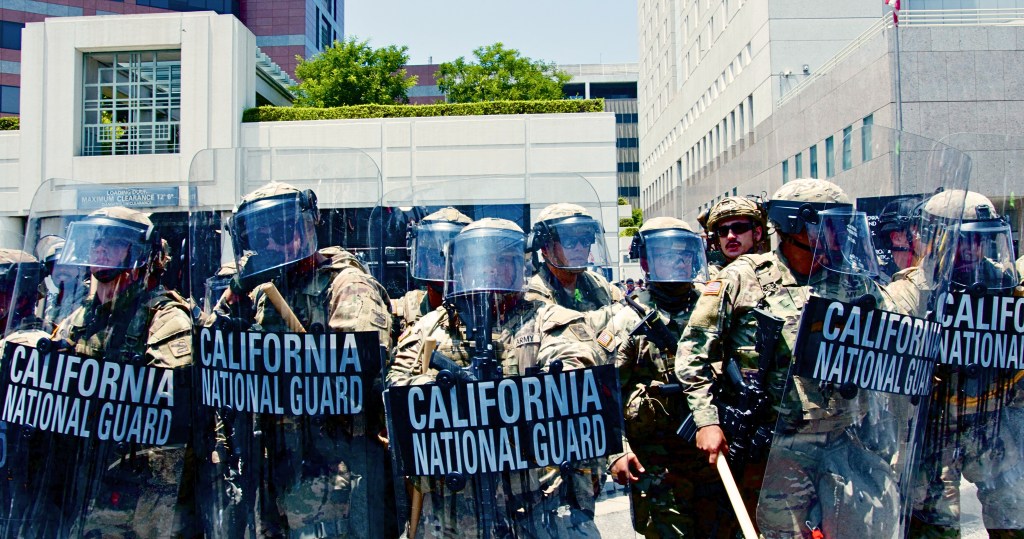
With the military takeover of the city, via federalized National Guardsmen and Marines, L.A. has become Ground Zero for the current anti-fascist struggle that expanded into Washington D.C., and which is now encroaching on Chicago and other cities.
Dozens have now been murdered and wounded by ICE this year, with that number most likely to rise by the time this is released. And at the point of production for this documentary, a reported 1,800 people are missing from the ICE concentration camp in Florida alone. Thousands of people have been kidnapped and disappeared.
Jaime Alanís Garcia was killed in a raid in Ventura County farmland, falling nearly 30 feet to his death. Day laborer Roberto Carlos Montoya Valdez was killed in an ICE raid at a Monrovia Home Depot location.
In an act of collaboration with the federal government, L.A. District Attorney Nathan Hochman charged 71 people with crimes at anti-ICE protests, with one, Adrienne Villa, a resident of the city’s long-standing “Skid Row” homeless neighborhood, receiving 14 charges and an unaffordable $1.33 million bail.
Villa was soon found hanged in her cell in June, only several hours after her arrest, but the details of her death were only disclosed by the Los Angeles Sheriff’s Department in August. She is the first anti-ICE protester to die in police custody.
The FBI also raided and harassed organizers with the Centro Community Service Organization (CSO) in connection with charges filed against Alejandro Orellana, an East L.A. activist who handed out face shields to demonstrators.
It has become clear that a diversity of tactics is necessary for the struggle against capitalism, imperialism, and fascism. Regardless of the legality or perceived “illegality” of these respective tactics and strategies, police and fascist repression have been a through-line across the board.
“We must be flexible; we must be able to employ the most varied methods of struggle, adapting them to changing conditions. At one moment, we must emphasize legal work, at another, illegal work—but always with the aim of strengthening the revolution.”
— Vladimir Lenin, “Left-Wing” Communism: An Infantile Disorder (1920)
What’s the right response? How do other areas prepare? Which tactics should you and the organization you’re in pick up? How can we organize this resistance to push back and launch a successful offensive against Capital? These are all prescient questions for organizers and revolutionaries in the belly of the beast.
“Peaceful” Protests and Mass Mobilizations
“The revolutionary must master all forms of struggle—from legal parliamentary activity to clandestine work, from economic strikes to armed uprising—and be ready to shift swiftly from one to another as conditions demand.” —Joseph Stalin, “Concerning Questions of Leninism” (1926)
From the No Kings protests to the ANSWER Coalition, we’ve seen massive “peaceful” protests throughout the county. Mass mobilizations from SEIU after their union president was arrested by federal Gestapo, to IBEW, UTLA, and other local unions have also been a semi-consistent trend over this current period of struggle.
There has been much discussion and debate, as there always is with this particular tactic, over its efficacy. There’s the obvious concern about political movements being co-opted into political theatrics with these events–the idea that political momentum gets sapped by less-than-dubious figures, especially in the case of the No Kings “organizers,” is not entirely out of the question. In the same way, we must be concerned by state or non-state agent provocateurs at these protests; we should be concerned about the ruling class co-opting our movement.
These types of NGO- or bourgeois-funded events largely involve mobilizing those who are not organized, liberal/progressive in their ideology, and overall not perceived as “revolutionary.” However, it usually involves mass mobilization of the general community. As we will get to, the organized or spontaneous, more radical actions usually draw a far smaller crowd. The Mayor’s office said only 30,000 people showed up to the No Kings rally in LA, but on the ground, it seemed significantly bigger. If I had to estimate, it was over 50,000. And across the country, it was 4-6 million people.
The idea that these crowds that don’t materialize from thin air–they must come from our communities–can not be organized and are stuck in liberal politics is a defeatist attitude. It’s not so much a “meet the people where they are” as it is; these are people clearly wanting political resistance. It’s up to us as communists and organizers to create the infrastructure for that energy to shift from tailist tendencies. The reality of Democratic and capital co-opting of the Black Lives Matter movement, Occupy, etc., is not proof these millions of people are hopelessly stuck—it’s proof we have still failed to meet the moment of struggle we are facing collectively.
Ironically, the bourgeois backing of the No Kings rally did not protect the “peaceful” protesters from LAPD and LASD shooting them with “less lethal” rounds four hours before the curfew. Peacefully protesting ICE kidnappings and fascist military occupation still leads to mass state repression. Mayor Karen Bass, who repeatedly has denounced the ICE raids and called for peaceful protests, still called in police gangs to shoot those peaceful protesters. It’s clear that with the fascist assault on this city and county that Democratic political leadership will collaborate while lying about that reality.
Could that repression and collaboration drive those liberal-minded working class people who attend the next No Kings rally more prepared to get organized? And what are we doing to create the space for those people to get radicalized and trained for the struggle?
Labor’s mass mobilizations for this have been underwhelming outside of the SEIU rally after David Huerta, the president of the California division of the Service Employees International Union, was arrested and charged with conspiracy. But there are unions like the United Teachers of Los Angeles (UTLA) that have strong connections to the Community Self-Defense Coalition, and massive overlap in union rank and file with community and radical organizations in the city. Let alone unions like UFW, UNITE HERE, and others being largely filled with Latino/a workers and immigrants.
This attack on the immigrant and Latino/a community is going to hit the labor movement hard, regardless of where these unions’ national leadership lands ideologically. So there is massive potential for radical action from the labor movement in this struggle that is a natural carryover from years of labor struggles in Los Angeles.
There have also been mass mobilizations from traditional and more liberal immigrant rights groups like The Coalition for Humane Immigrant Rights (CHIRLA). They spearheaded the Sanctuary City ordinance being passed in preparation for this current period and have mobilized for protests sporadically throughout the last couple of weeks in direct response to the ICE raids. However, it must be stated that the Sanctuary City ordinance has completely failed to protect our communities. The law was supposed to stop LAPD and city infrastructure from helping ICE and Border Patrol; however, all the experience on the ground has shown they collaborate to terrorize the city, and new reporting shows they are sharing resources to assist directly in ICE kidnappings.
But it’s not just these traditional organizations leading mass mobilizations and protests in response to this fascist assault. The aforementioned Community Self-Defense Coalition (CSDC), Party for Socialism and Liberation (PSL)/ANSWER Coalition, and Democratic Socialists of America (DSA) have all led mass protests in response to and in preparation for this struggle. There’s been a resurgence of the Chicano movement as well, and that can’t be ignored. Union del Barrio and Centro CSO, both Chicano community organizations with socialist and communist leanings and connections, have been instrumental in mass mobilizations in South Central, downtown, and East LA barrios. Also, as we will see later in the article, they have been key in other tactical approaches.
Mutual Aid
“The goal of socialism is not only to abolish the present division of [humanity]…but to replace competition with solidarity.”
–Vladimir Lenin, The Socialist Revolution and the Right of Nations to Self-Determination (1916)
Another tactic that has been deployed and expanded is mutual aid networks and efforts. This attack on the immigrant community in Los Angeles has caused mass amounts of people to stay home, not go to work, avoid doctors’ appointments, and hide from this fascist terror. There has been a concerted effort from organizers to make sure people stay fed and secure materially throughout this, which has to be replicated in other places when the state infrastructure completely fails the community.
Groups like Mutual Aid LA, Midnight Books, All Power, and others have been dedicated to the distribution of supplies to protesters and community members. Centro CSO member Alejandro Orellana was raided by the FBI, arrested, and charged with “conspiracy to commit criminal disorders” after giving out masks during a protest to protect community members and peaceful protesters from police shooting rubber bullets.
There have already been many cases over the last few weeks of protesters and media being hurt by rubber bullets and going to the hospital. We are now seeing mutual aid be criminally persecuted along with protesters. This threat against Centro CSO should be a rallying cry for other organizations to mobilize when necessary in solidarity, lend legal aid, and provide more forms of mutual aid support.
Rapid Response Networks & Community Patrols
“The weapon of theory is as decisive as the theory of weapons. But while we must be ready to fight with arms, we must also fight with culture, education, and political mobilization. The enemy uses many forms of domination; we must respond with many forms of resistance.”
— Amilcar Cabral, “The Weapon of Theory” (1966)
One of the most essential and expanding tactics is the rapid response networks that have developed as a result of the increasing ICE raids. The Community Self-Defense Coalition has over 80 member organizations including Union del Barrio (UdB), Centro CSO, AUSIIME Collective, Association of Educators-LA, Black Alliance for Peace Socal, Black Men Build, Educator Defense Network, Jewish Voice for Peace, Harriet Tubman Center for Social Justice, Anakbayan, National Laywers Guild, UAW 4811, If Not Now, LA Street Care, Raza Unida Party, People’s Struggle SFV, CPUSA Southeast LA, MECha’s throughout the area, and dozens of other organizations and locals.
Groups like Union del Barrio, People’s Struggle, and Centro were instrumental in setting up the rapid response network infrastructure that the rest of the coalition partners are trained in and then become an active part of the regional networks. There are hundreds of organizers and activists responding to calls of ICE deployments, educating the community on their rights when approached by federal and police authorities, and setting up routine patrols to search for ICE and Border Patrol groups. Centralized communication and hotlines across almost the entire Los Angeles organizing spaces have become essential to quickly respond to these ICE kidnappings.
The rapid response network and connected community patrols are the backbone of the entire resistance to this fascist occupation and violation of our neighborhoods. There’s a reason why fascist Senator Josh Hawley is trying to launch investigations into Union del Barrio and CHIRLA–another organization with a rapid response network. UdB responded to the letter from the senator:
“Mr. Hawley’s June 11th letter claims that Unión del Barrio provided “logistical and financial resources… aiding and abetting criminal conduct…” To be clear, Unión del Barrio has not organized, aided, abetted, financed, or engaged in any illegal activity, and we reject Mr. Hawley’s notion that we are somehow responsible for “lawless mob actions.”
Clearly, the objective of Mr. Hawley’s letter was to intimidate us and compel Unión del Barrio to stop organizing the self-defense of our communities, to silence our communities into submission, and to rewrite history as to who are the actual violent criminals behind these events…Anyone who cares to pay attention has witnessed how these protests were rooted in a rapidly growing number of intentionally cruel, increasingly violent, militarized immigration operations across the United States.
These Los Angeles protests took place as a direct response to the ongoing 159-day colonial reign of terror unleashed by the federal government of the United States against La Raza…Unión del Barrio is a disciplined organization with a politically united membership that acts collectively, not as individuals. Our members participated and continue to participate in protests throughout the LA area and Southern California. Furthermore, we intend to play a leading role in a national movement against ICE/migra attacks.
Unión del Barrio has already provided an effective model for community self-defense, and we are putting our theories into practice. We have informed our members and supporters of the situation, and we have instructed them to remain on high alert in response to ongoing ICE/migra repression.
However, we will remain steadfast. Unión del Barrio will continue to expand, strengthen, and increase our community-centered barrio-facing work, such as our Community Patrols and our youth, prisoner, worker, and mujer-centered projects to build dual and contending power.”
Other groups like the Harbor Area Peace Patrols and the aforementioned Long Beach Rapid Response Network have been a natural outgrowth of both the Coalition and the effectiveness of community patrols. The former being the key watch for all ICE vehicles leaving Terminal Island–a common staging ground–and the Long Beach collective being the frontline of all ICE movement from Terminal Island. It is unknown how many lives have been in effect saved by these patrollers, but the number is in the thousands after 100 days.
In any struggle, it’s imperative to know where the enemy is, what the balance of forces is, and where to concentrate your forces. The rapid response networks and community patrols are the first line of defense and information gathering, which is vital to this resistance movement. We have to know where the fascists are and where they are gathering strength so we can do the same to counter that invasion in our communities.
Community Defense and Blocking ICE Raids
“The guerrilla fighter is like a fish in water, and the water is the people. Without the people’s support, the armed struggle is doomed. But without the armed struggle, the people’s resistance remains fragmented and easily crushed.”
—Amilcar Cabral, Unity and Struggle (1974, posthumous compilation)
A natural outgrowth of the Know-Your-Rights neighborhood and workplace education, community patrols, and the rapid response network’s rising social media reach is the spontaneous clashes with the police and federal authorities. There have now been numerous occasions, such as in Paramount, Compton, Bell, and other places, where the community has spontaneously reacted to ICE raids. Some resulted in ICE and federal agents being blocked in by the community trying to defend their friends and family from being kidnapped and disappeared. Others resulted in quick clashes where the ICE was able to get away.
Community defense actions in Paramount and Compton in particular lasted well over 12 hours with wave after wave of people trying to get closer to ICE’s battle formations while being shot at, tear-gassed, and clubbed. Barricades were set up and items burned–classic revolutionary guerrilla tactics that were again, spontaneously developed in these instances.
“The Moscow uprising thrust the barricades into the forefront. But the barricades were of little use… The barricade is not a fortress; it is only a hindrance to the troops. The insurgents must not remain passive behind the barricades, but attack relentlessly.”
— Lenin, Collected Works, Vol. 11, p. 174
As Lenin clearly stated lessons learned from the failed 1905 Russian Revolution is that this type of street combat between police and the community is defensive. It’s not an offensive tactic to set up barricades and try to block ICE raids. These are attempts at community defense, revolutionary, yes, but not organized offensive insurrection. That’s just not what’s happening on the ground. The Los Angeles uprising is one centered on community self-defense. What continues to develop could change that reality, though.
Armed Struggle?
“It was only when all else had failed, when all channels of peaceful protest had been barred to us, that the decision was made to embark on violent forms of political struggle… I do not deny that I planned sabotage. I did not plan it in a spirit of recklessness, nor because I have any love of violence. I planned it as a result of a calm and sober assessment of the political situation that had arisen after many years of tyranny, exploitation, and oppression of my people by the whites.”
— Nelson Mandela Statement from the Dock at the Rivonia Trial (1964)
Los Angeles and Southern California have historically been a key center of armed struggle and community defense in the class struggle in the US.
Los Angeles is also a site of settler colonial genocide and resistance. In 1827, for example, there was a massive revolt of the Chumash nation against the settlers of the area. Throughout Spanish, Mexican, and American colonial occupation, Indigenous resistance has been a constant. California was also a brutal site of “triple slavery” of Indigenous, African, and Chinese people being enslaved in the region at a concurrent time. California governors has explicitly called for Indigenous genocide and “wars of extermination.” Capitalists in LA shipped gold to the South during the Civil War as the “Los Angeles Mounted Rifles,” a proto-fascist militia similar to the KKK, would rally in the streets. Mass lynchings and massacres by white settlers against oppressed groups were a key feature of California throughout the 19th century.
But California also would be an early and vibrant place for socialist thought and activity from the late 19th century onward. Utopian socialist colonies like the Kaweah and Llano del Rio Colonies were dotting the southland from the 1880s.
In 1932, in response to rising fascist gangs both locally and internationally, Communist Party USA leader Ben Dobbs recommended that the Young Communist League in Los Angeles should become a “semi-military organization,” in direct response. Party members were trained in Moscow for revolutionary guerrilla action, such as how to build barricades and Molotovs. 20 years later, the entire leadership of CPUSA in California was on trial for the Smith Act.
There were mass popular uprisings like in Watts in 1965 which historian Gerald Horne said “marked the moment when the ideological baton in Black America moved westward…” And after the Watts Rebellion, the Community Alert Patrols formed in LA. Similar to the anti-ICE patrols of today, community members would patrol and “protect and observe” in the community against police brutality. It was born out of and from community members organizing in the Communist Party associated Hugh Gordon Bookstore. And the organization of the Community Alert Patrols was a direct harbinger to the Black Panther Party and the Black Power movement to follow.
Between groups like the Black Panther Party, the Black Liberation Army, Weather Underground, and more, there were 2500 bombings in the US from 1971-1972 alone. Police shootouts with revolutionaries from the Bay area to San Diego were not uncommon, as at least two dozen Panthers were killed by cops during its brief history. During the first half of 1969, there were at least ten armed police and FBI raids on the Black Panthers, most notably the assault on the headquarters in Los Angeles.
There was international military aid given to Black Revolutionaries in that period from the anti-imperialist and socialist blocs: Algiers, Palestine, Cuba, Vietnam, and Czechoslovakia.
Jonathan Jackson’s armed assault on the courtroom in Marin County became a societal lightning rod. Likewise, the murder of his imprisoned brother George Jackson in San Quentin prison sparked revolts across the country. This led to the infamous trial of former Black Panther and at that time, current Communist Party member and UCLA professor, Angela Davis.
A recent study said, “No Panther branch or chapter experienced more harassment and suffered more casualties than the L.A. Panthers…being a Panther in Los Angeles meant putting one’s [life] in peril on a daily basis.” Panther co-founder Bobby Seale said the LAPD would “shoot up our free clinic…they shot it up so much that the doctors and nurses…some 7 or 8 of them that were donating their time down there, decided to leave, because they just got scared.” Chicano leader Corky Gonzalez said California and Los Angeles were “the number one police state and city in United States history.”
And in recent decades labor unions and tenants associations have been growing in militancy. The famous 2006 Day without an Immigrant protest that gathered a historic 500,000 people in protest in Los Angeles. As historian Gerald Horne wrote in his book Armed Struggle: “By mid-2023 one analyst adjudged accurately that ‘Southern California unions and the working people they represent have become the vanguard of the American labor movement. About half of the big strikes in the U.S. this year,” said historian Nelson Lichtenstein, “have taken place in California with the most consequential centered in Los Angeles.” This city was portrayed accurately as a “cockpit of labor militancy” as the “City of Angels is setting the pace for millions of working people across the nation.”
And then in late 2023 and through 2024, we had a militant movement in solidarity with Palestine primarily organized through the Palestinian Youth Movement as the vanguard in coalitions that culminated in the Student Intifada. Police and zionist gang assaults on student encampments were widespread but most concentrated at UCLA.
There are lessons to be learned from all of this history. The lack of international material support in the later years of the Black Panther Party, due to Eldridge Cleaver’s eclecticism, shows that international aid and support are imperative if this shift from spontaneous community self-defense to organized armed struggle is to occur. One thing Los Angeles has demonstrated is that there is already mass community support for the current tactics on display.
There isn’t any real outrage here over ICE raids being blocked or some AI cars being burned. The rage is pointed at the fascist police and federal agents. Is the community enraged enough to support organized armed struggle? It’s impossible to tell, but the reality is that the current diversity of tactics is testing Los Angeles’s organizational logistical capacity.
“An insurrection must not be viewed as a spontaneous outburst, but as a carefully prepared and organized action. The art of insurrection demands the concentration of superior forces at the decisive moment and place.”
— Joseph Stalin, Foundations of Leninism (1924)
We are clearly in a period of mass unrest and resistance to fascist aggression. Organizers are deploying all available tactics, and some organizations are employing multiple. From mass protests and mobilizations, mutual aid, community patrols, rapid response networks, know-your-rights education, and more, all are building up community capacity for spontaneous direct action. Organizers in other areas need to develop similar Community Self-Defense Coalitions with radical and revolutionary collective leadership, and prepare infrastructure for the oncoming fascist repression.
Organizers must rapidly expand mutual aid networks, rapid response networks, and coalitions into permanent structures of dual power—community kitchens, medical collectives, and defense committees that outlast this wave of repression. The rapid response model must evolve into neighborhood assemblies capable of coordinating strikes, boycotts, and armed resistance when necessary.
The 1985 MOVE bombing, the 1965 and 1992 L.A. Rebellions, and the police assault on the Black Panther Party in Los Angeles prove the state’s willingness to escalate to massacres. If armed struggle emerges, it must be disciplined, clandestine, and rooted in mass support—unlike the isolated actions that doomed the Weather Underground.
The last time we saw this level of armed struggle here, the US used Smith Act trials to arrest all state and local communist leaders, used COINTELPRO tactics to assassinate, disappear, and lay siege to communist organizers in the Black Panther Party, Chicano Movement, and CPUSA. Solidarity and material support are vital for community defense.
Historian Gerald Horne advised organizers who may be going down the path of armed struggle that they:
“Should have an analysis…An analysis of the correlation of forces domestically–who will be our allies–who will be our antagonists? Above all, an international analysis. I hope they have been in touch with our comrades in Cuba…that they try to rally international support. That would be my only cautionary note…with regard to a replay of the 1960s and 1970s…The uniqueness of the Southland—proximity to Mexico; proliferation of colleges; serpentine freeways; brutal cops; an empowered ultra-right—also served to propel both the [communist movement]…the problem in the U.S. was an assessment of the correlation of forces domestically and globally in light of the perniciousness of class collaboration that inhered in settler colonialism at home.”


Leave a Reply