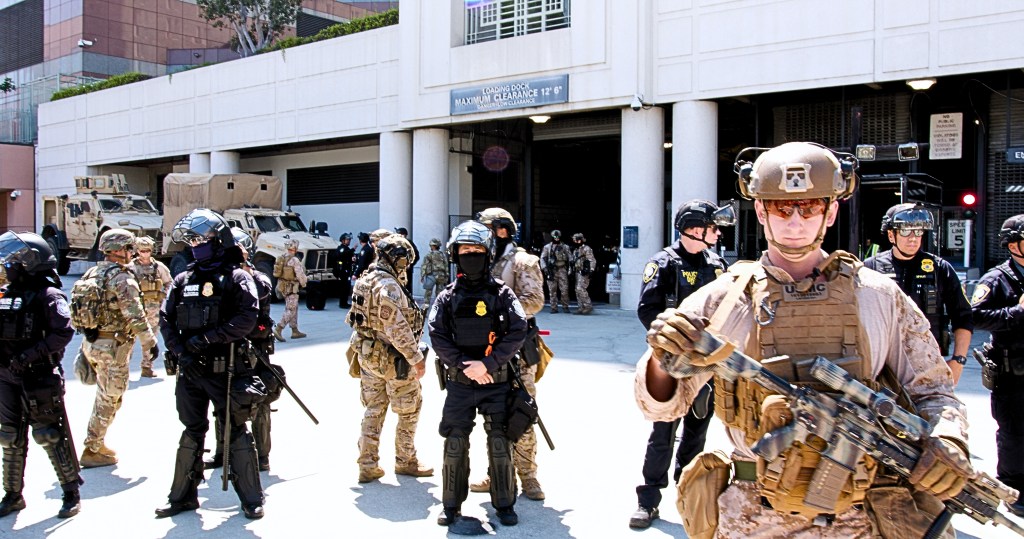
With the increase of fascistic violence from the Department of Homeland Security (DHS) and its subsidiaries, Immigration & Customs Enforcement (ICE) and Border Patrol, and the growing federal occupation of U.S. cities, it is imperative for organizers to compile “How-To” guides to help others resist this oppression.
Comrades from Minneapolis have put out an excellent breakdown of their resistance model, and I wrote previously about the model in Los Angeles. However, my article did not go into the exact structures, how they formed, best practices, or policies.
I hope to expand on the details provided from Minneapolis—which is quite close to the various models in LA—in the hopes it can benefit organizers in other places not yet targeted by Trump’s fascist domestic military force. The purpose of this guide is not necessarily to be copied 1-for-1, but for members and comrades of other communities outside L.A. and Minneapolis to see what can be applicable in their respective areas of struggle.
All rapid response networks (RRNs) use group chats (mostly via encrypted applications, but unsecured apps like WhatsApp are often used by community members), video chats, in-person meetings, know-your-rights trainings, etc. to various degrees. There are the main, vetted chats for seasoned members, which run long-term strategy and are used as a main hub for sharing info that needs to be distributed to the entire collective. Then, there are groups separated by region and by type of action. There can be patrol chats that are set up for deletion after that day or week’s work, while whole regional chats act as mini-hubs for larger collectives and coalitions.
In larger coalitions, it is common to have standing committees for things like community outreach, education, media, security, etc., that will cover particular necessary tasks for organizing and mobilizing. For example, who creates the flyers and social media posts? Who will run the KYR trainings? Who will talk to the media? In larger and more organized collectives, these tasks are often delegated to committees that meet regularly and give report-backs to the larger collective.
Community patrols and community hubs are key tactics being used to defend our communities. The available logistics, area of coverage, and people power will shape how patrols and hubs are managed.
Community patrols, which are performed by teams of people in cars, actively look for ICE activity and respond to alerts. Community hubs are key sites where people often visit or congregate and where ICE is targeting people regularly.
If you don’t have many people to fill shifts of daily patrols and hubs, or are covering too large an area, it could be beneficial to identify key sites to set up hubs as a priority. Identify locations in your community like Home Depots, car washes, known hotspots for street food vendors/taquerias, etc., and plan for at least two people at the major sites. Establish a presence and build ties and relationships with the people impacted by, and scared of, the fascist violence.
It’s essential to build these connections and obtain community “buy-in” because they will amplify your popular power and bolster community defense operations. Hubs can act as great spots to outreach as a result of their often well-trafficked nature.
It is also essential to establish hotlines that allow the public to easily call and contact the RRNs. When you are communicating with day laborers, vendors, etc., make sure you have physical material to give them. Flyers, information sheets, KYR cards, and a way to reach the RRNs for help when they need it.
Not everyone in the community needs to actively be part of patrols or other such activities, but if the majority are aware of you, aware of how to reach you, or know to alert other centralized systems like StopICE.net, then you multiply your RRNs’ organizational and mobilization ability to keep your neighbors safe, by building trust with the community and giving them the ability to participate in their own defense.
If you have more than enough people power to cover major sites with daily Community Hubs, then roving community patrols along main streets and common access routes for ICE is the next step up. If the area’s street layout permits, do it in a gridlike pattern. This is another opportunity to do community outreach and inform the community about the rapid response network and their rights.
It’s also common for alerts to go up on social media, be sent to the hotlines, or be posted on websites that aren’t at a hub, so patrollers must actively respond to those alerts as quickly as possible. Depending on the kidnapping attempt, it’s a matter of seconds to minutes before the victim is in federal custody; we have to at least document the event and get the victim’s identifying information.
Tailing ICE and CBP convoys is another common tactic that is not always encouraged, depending on the collective. However, it would be foolish to act like people aren’t engaging in this tactic often, so we will discuss it.
Following from a safe distance, and not doing it alone, is preferable. Constant communication with other organizers on the ground about the location of fascists is necessary to make community defense effective. Knowledge of the area and the people living in it is important too, so you can better expect where they will be heading.
Legal and aftercare for those directly affected by this fascist violence is a necessity. The National Lawyers Guild, Immigrant Defense Network, and other organizations must be involved in coalitions. Though many RRNs and other groups have started to increase mutual aid efforts to take care of the families of those kidnapped and brutalized, the need for care should to be highlighted and examined so organizers in community groups can figure out how we can scale these projects up to entire neighborhoods and cities.
In the event that ICE/CBP agents are cornered by the community or organizers, in effect leading to a standoff, it’s important to be aware of the balance of forces. Are you outnumbered? Are they outnumbered? How many federal agents and policemen are there? Are media or legal observers present? Are there medics available if things get tough? Do you know where specifically you can escape if you need to?
Direct action must be tactically and strategically approached. We don’t want people needlessly arrested or brutalized by fascists. A comrade in a jail cell or a hospital bed is a comrade demobilized from the fight. It’s important to remember this will be a long struggle. The outcome won’t be decided by one street clash, so remember to be like water, and keep yourself and each other as safe as possible. Street barricades, counter-fireworks, umbrellas, personal protective gear, and other such tools need to be considered when street clashes become commonplace, as they did in Los Angeles in the summer of 2025 and in Minneapolis in early 2026.
Rapid response networks are not always set up the same way. Some are autonomous or “affinity” groups that spontaneously formed and mostly lack concrete internal structures. These tend to be very fluid in terms of allowing new members, and will rarely “use peace police” tactics, and lack definitive leaders. However, this fluidity often leads to political eclecticism, which can create internal conflict and contradictions.
For example, in these autonomous RRNs, it is common to have communists, anarchists, progressives, liberals, and somewhat apolitical people all be involved. Notions among members about structure and internal democracy, let alone about tactics and strategies, can vary dramatically. And, without defined leadership, rules or guidelines, or a political vision, there’s a major concern about these groups having long-term viability. There’s also concern about whether these groups can adequately adapt to rapidly changing material conditions without these organizational institutions in place.
Some RRNs are initiated and run by NGOs like the Coalition for Humane Immigrant Rights L.A. (CHIRLA) here in Los Angeles. There are obvious pros and cons to these formations. They usually have dedicated, paid staff to oversee the administration of the network. There tends to be more funds for materials and other actions as well. But there isn’t a radical political vision within the NGOs. They work within the bourgeois framework, so the question arises: if fascist political violence increases, can they adapt to the moment that would require more militant resistance?
Other RRNs, like the ones affiliated with the Community Self Defense Coalition (CSDC) in Los Angeles County, feature more “communist party”-esque principles combined with some characteristics of a big tent “affinity”/autonomous group. There is a base set of political principles and points of unity, such as: “End police & ICE terrorism in our communities!” “NO to Raids, Deportations & family separation!” “Money for Public Education and Social Services!” “Not Fascism or Genocide!” “End US intervention in Nuestra America, Africa, Asia, Middle East. Close ALL Concentration Camps (Immigration Detention facilities, Prisons)!” “We will NOT collaborate with ICE, police, sheriffs!” “This Land belongs to Indigenous people; (Tongva, Kizh, Chumash, all original protectors of the land)!” and “We will struggle for Self-Determination for ALL oppressed people and our future generations!”
All of these points of unity have to be accepted by individuals and organizations that join the CSDC, which coheres a set political vision that autonomous groups don’t tend to have. But there’s also not a detailed, long-term political economic system being proposed, thus allowing many different political ideologies to work together within the coalition. The CSDC also has a set steering committee with members of various coalition member organizations that have authority and responsibility over the coalition.
Rapid response networks are developed with a variety of structures and political currents and must be built with knowledge of the conditions on the ground of the community in which they were set up. The tactics and strategy being used by anti-fascist forces are not uniform. However, there are commonalities to be seen across the different battlefields–whether it’s Los Angeles or Minneapolis.
We must continue to learn and educate each other about what’s happening on the ground, as the resistance to fascism and capitalism constantly morphs and develops into something new.
Join, or help to start, your local community defense groups and rapid response networks. Starting can be as simple as knocking on your neighbors’ doors and asking their names. There is a long fight ahead, and we will have to know each other well if we want to win.


Leave a Reply