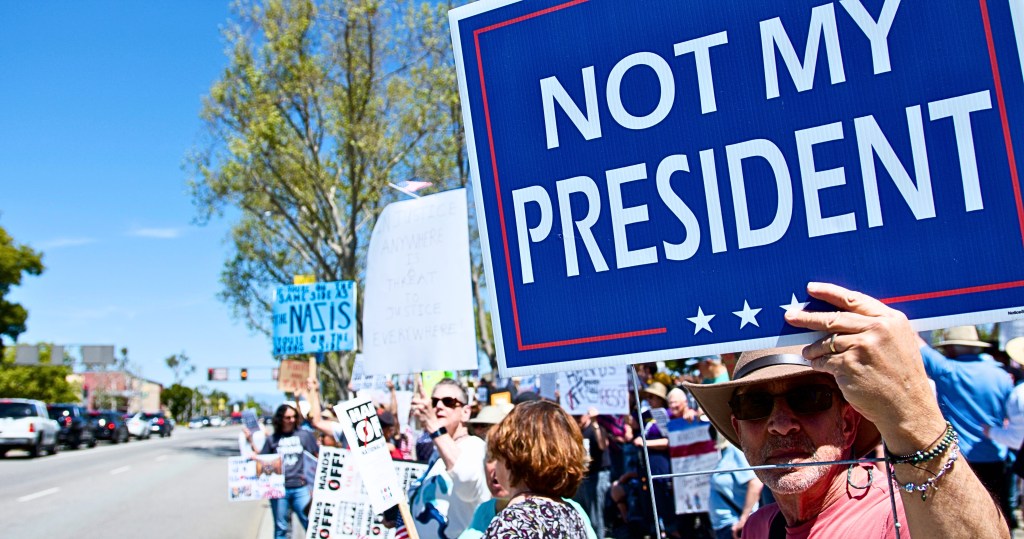
LAKEWOOD, Calif— The national Hands Off event on April 5 led to mass rallies and protests across the country. With the fascist onslaught against social services and working class rights, organizers in the infamous suburb of Lakewood pulled off a historic protest. In perhaps the largest protest in Lakewood city history, over 4,000 people crowded both sides of the street outside the city hall and Los Angeles Sheriff Department station.
Lakewood Indivisible organized the rally, and when interviewed by People’s World, the lead organizer, Heather Rodriguez, said, “It’s a lot more people than we expected, but we know that people are passionate, and everybody cares about something that’s being threatened by this administration. So there’s a lot of people that have a grievance and a lot of people that want to be here and help protest.”
The city of Lakewood is best known for the “Lakewood Plan,” which was a suburban development plan that pioneered our current non-walkable cities built around shopping malls. Most importantly, as detailed in Mike Davis’s City of Quartz, Lakewood was one of the key sites of “white flight” from downtown and west Los Angeles. The city made a deal with the county supervisors to “contract its vital services…at cut-rate prices.”
The genius of this idea is that it would be financed by a regressive sales tax instead of progressive property taxes. So with zoning out “service-demanding low-income residents and renting population,” the Lakewood Plan safeguarded petty-bourgeois, mainly white, property from Black and Brown people. Gary Miller in Cities By Contract referred to the Lakewood Plan as a “revolt of the rich against the poor.”
However, the dynamics of Lakewood have shifted since its inception. For example, in 1970, the population was 98.5% white—today, it’s down to 31%. The majority of the city is now multi-racial and multi-national. Also, about one out of ten people are over the age of 65 and are eligible for social security, and one out of five were born outside the US.
Heather Rodriguez, when asked about the importance of a suburb like Lakewood now experiencing class struggle, said, “I think that there’s been a lot of groups of people that have been historically ignored. I think we see a lot of people here that are older, that are senior citizens, who are at risk for having their medical [benefits] cut, their social security cut, a lot of these things that we rely on. And I think it’s easy to think that being in a suburb, people are very settled and not very many activists. But these people are so passionate about it as well. Sometimes they just need a rallying cry to get everybody active.”
One of the critiques from the Left of the Hands Off event messaging was the focus on “Hands Off NATO” and the lack of focus on the US and Israeli genocide against Palestine. When asked about this criticism, she responded, “I think that is one of the problems that I’ve seen from especially younger Democrats. A lot of them chose not to vote for Kamala [Harris] because they felt like she was too soft on Israel’s genocide of Palestine. And I think that’s a missed opportunity [by the Democratic Party]…You don’t have to mire yourself in debates over different people’s techniques. You can just say that there is people suffering in Palestine, and they need to be protected, and genocide is wrong no matter who’s perpetrating it..I think that’s a massive misstep for a lot of these more center-left groups…Indivisible’s national stance is to support Palestine.”
Thousands of people mobilized in a historically suburban and petty-bourgeois community because Trump is attacking the working class and oppressed people. New mass organizations like Lakewood Indivisible have formed and are starting to bridge this geographical gap in Los Angeles organizing.
As Rodriguez said, “If you are interested in doing something like this in your hometown, start it. Join another [organization] if you can. Make one of your own…” The city of Lakewood has never seen class struggle to this degree, showing there’s rising consciousness among people and communities that wasn’t there before—is a new qualitative stage of the struggle approaching?


Leave a Reply