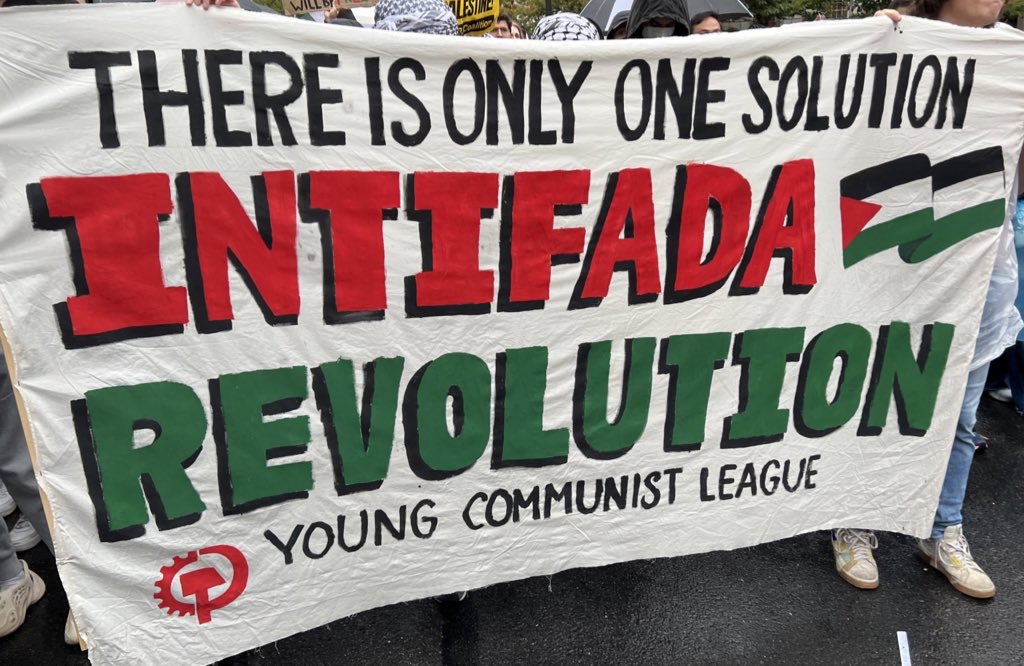
The CPUSA party program is the guiding line for the party nationally and locally. It lays out the multifaceted class struggle in the US—that working class exploitation, and racial, sexual, gender, and national oppressions are interconnected in the class struggle here. The international system of capital exploitation and extraction for the benefit of multinational monopolies and financial oligarchs—imperialism— is connected to the international working class struggle and also our “everyday living.”
“The Communist Party USA is dedicated to the struggle for socialism in this country and peace throughout the world. This is our program…We, the working class and people of the United States, face tremendous problems: exploitation, oppression, racism, sexism, a deteriorating environment and infrastructure, huge budget deficits to pay for tax cuts for the 1%, and a government dominated by the most vicious elements of big capital and its political operatives. We face the problems of everyday living, making ends meet, and having a voice at work and in our communities.”
In the last decade+, we have seen an increasing amount of the most reactionary section of the capitalist ruling class, and we must build a broad people’s front to combat that reactionary and fascistic rise. We must engage in the struggles not only in the labor movement but the LGBTQ+, racially and nationally oppressed struggles to combat the backward sections of the ruling class,
“The extreme right is led by the most reactionary, militaristic, racist, antidemocratic sectors of the transnationals. They gain support for their extreme right agenda from other backward political trends, most of which are misled as to their real interests, sometimes blinded by the propaganda of fear and scapegoating, by racism, sexism, right-wing nationalism, anti-Semitism, homophobia, and xenophobia.”
“In constant battles over issues large and small, the working class learns that more fundamental changes are necessary to have a truly humane society. The struggles for the immediate demands and reforms needed by working people today are essential steps toward our ultimate goal of the revolutionary transformation of society and the economy, toward socialism and then communism—an even higher stage of social and economic development…The appeal of a communist society is a response to the real human needs of the masses of people. Communism will enable people to set aside worries about health care and education, about losing their livelihood and their dignity. Communism will eliminate the economic insecurity of the masses of working people. Instead, it will offer us the opportunity to reach our full human potential.”
“When workers struggle against the capitalist class or any part of it on any issue with the aim of improving or defending their lives, it is part of the class struggle. In every area of workers’ lives, the fight is to defend themselves and their families from corporate assault.
The class struggle also takes place in the political arena. It plays out in struggles over governmental action or inaction, over social spending and tax policy, over elections, and ultimately over which class or formation of class and social forces becomes dominant in holding and exercising political power. The class struggle also exists in the realm of ideology, between social and political ideas and values that justify the political and economic policies of the contending classes.”
The class struggle will be fought on economic, political, and ideological lines, and the communist party must engage in each of these realms of struggle for the betterment of the working class. It must engage in each link in the chain of class struggle. Building a broad, multiracial, and multinational front to combat US capitalism is a necessity. Struggles for indigenous sovereignty, African Americans, Puerto Rican sovereignty, women’s rights to healthcare, voting rights, etc. are struggles against capitalistic exploitation and the superstructures it has created.
We are ultimately fighting for the protection and increase of democracy.
“The desire of people to actively participate in decision making drives battles for voting rights, expanding the electorate, reforming the electoral system, protecting civil liberties, guaranteeing civil rights, ending all forms of discrimination, eliminating the power of large financial contributions that enables the rich to dominate elections, and ending all forms of exploitation. The constant struggles of the working class to expand its political power and opportunities are struggles to expand democratic rights. The fight to protect and expand union rights is a fight for democracy…Another area where democratic rights are under attack is the public space. Efforts to bar protest on public property, to force organizers to pay for insurance for demonstrating in public places, and to criminalize protest are on the rise. At the same time, decriminalizing violence against demonstrators and demonizing those who object to the steps toward fascism is the order of the day.
Finally, democracy is restricted in the workplace. In reality, workplaces often function as dictatorships. Only where unions have forced limitations on corporations do workers have some voice in the economic and workplace decisions that impact their working lives. Even the limited victories that have been won are constantly under attack. Workers deserve democracy on the job as well as in their communities. Workers deserve a say in the economic decisions that determine the quality of life of their families.
We must sharpen our understanding of the class nature of the ways that democracy functions differently under capitalism and socialism, and of how to fight to expand people’s rights…The class struggle and the democratic struggle are closely linked; they overlap and intertwine. However, they are not identical. The class struggle in an immediate sense pits groups of workers against specific capitalists at the point of production as well as in broader social and economic struggles. The aim of working-class struggle is to subordinate capital to the will of labor. In the long term, this means winning power to construct socialism. The aim of the democratic struggle is to advance equality in all its forms and in all arenas and to widen the democratic space for all working people as much as possible.
The interaction of these two streams objectively advances the struggle for socialism because socialism is necessary for us to permanently eliminate inequality. After a revolution, a qualitative change happens, with democracy progressing in a planned process in harmony with the dominance of working-class power. The victory of socialism will open a new stage in the continual development of democracy.”
We must analyze our concrete material conditions to build that broad popular front and at each successive stage of the struggle,
“Analyzing the objective stages of struggle is essential to developing correct long-term strategy. This is not a mechanical prescription; these are stages of struggle, not stages of social development from one socioeconomic system to another. The social system remains capitalist during all stages up to the conquest of power by the working class. There is no firm, complete barrier between these stages. In the current stage, while identifying the most reactionary sector of the transnationals as the main opponent and developing an anti–extreme right consciousness, Communists seek to grow anti-monopoly consciousness and class and socialist consciousness.”
We must build alliances with the progressive forces available to us at each stage of the struggle, recognizing the contradictions but not being scared of them.
“There are struggles within both the Democratic Party and within the labor and people’s movements, which are reflective of the overall struggle to gain political independence from corporate dominance. The Left must help build the movement against the extreme right, while strengthening the ability of the working class and its allies to effectively exert their will through massively broadening and deepening their organized reach. Any serious strategy that hopes to win millions of people to a more advanced political program must contend with this reality and relate to these struggles.”
As the fight against fascism is the current stage of struggle we must remember,
“Once the most reactionary extreme right transnationals receive a major defeat, it will be both necessary and possible for the people’s democratic forces to take on the transnationals as a whole. This more advanced, anti-monopoly stage of struggle will be the next key step on the road to socialism in the U.S.” (check 15-point proposal policies for the anti-monopoly coalition that will maintain itself after the defeat of the extreme right and the need to build a ‘People’s Party’)
The achievement of defeating the far right, building an anti-monopoly coalition and “Peoples Party,” gaining major policy wins and a semblance of political power is “…not enough. So long as the capitalists and transnationals own the means of production and are able to command political and economic power, new social problems will emerge, and old ones will be reintroduced in new forms. A full, lasting solution to modern social, economic, and environmental problems requires socialism, starting with social ownership of the key major sectors of the economy and working people’s democratic power led by the working class.
The wider and deeper the unity of the anti-monopoly coalition, the more the working class and its key allies lead it, the stronger the Left and socialist-oriented sector, the bigger and more influential a mass Communist Party, more the power of the transnationals will be curbed by radical measures. These will make easier the move to the next stage of struggle, the direct struggle for immediate revolutionary change.”
And finally,
“We see revolution as a profoundly democratic process, one that involves the actions and decisions of the vast majority. The more unified the majority, the more likely it is that a transition can be accomplished without the capitalists using violence to block the building of socialism. We reject all approaches that welcome and seek violent action. We fight for and commit ourselves to building enough unity to win socialism peacefully, though we recognize that the ruling class may initiate violence against progressive and radical movements in an attempt to maintain its power. We have no illusions that the capitalists will willingly give up power and control unless they have no possibility of successfully stopping social transformation by initiating capitalist class-led violence.
A revolutionary majority, based on mass organizations and political parties, must work to make it politically impossible for the former ruling class to use political or military means to return to power. As with all governments, should any forces try to take power by unconstitutional means, by coup or counter-revolutionary insurrection, the full weight of the government and mass people’s power would be used to uphold socialist legality and working people’s power…The struggle to achieve power and construct socialism will be difficult. The capitalists have great resources and great determination to keep their riches and power.
For an organization to play a leading role and develop strategy and tactics that fit the objective circumstances requires Marxist-Leninist analysis based on the actual material conditions of society. It requires the ability to influence millions, based on long experience of common struggle and mutual respect. It requires a Communist Party steeled in action. A leadership role in the struggle for socialism is not proclaimed; it can be won only through millions of working people gaining direct experience with a Communist Party, with its deeds, and with its application of theory to real struggles. A Communist Party must win this respect anew at every step of the struggle.
We do not propose any detailed plan for exactly how this transition will come about, since it will depend on the specific circumstances at the time. Revolutionary transformations have happened differently in each country that has gone through such a transition. In some cases, it was under the leadership of a single party, in others it was a multiparty coalition. In some, it came as a result of a direct struggle for socialism; in others, socialist goals only came following an anticolonial or anti-imperialist revolution. We can’t predict the exact challenges we will face; we can only focus on building a revolutionary movement strengthened and seasoned by participation in mass struggles.”
This is the summary of the program, its key elements, and its analysis. It’s a living program, due to change as the material conditions and stage of struggle change, but this is the guiding line for the party at the moment and it must be thoroughly understood and analyzed by party members and all those who call themselves communist in the US. There is room for improvement and/or clarification within the program. It was originally drafted in 2005 and then updated in 2019, meaning, its skeleton is from the liquidationist Webb years of the party. It’s rooted in time and material conditions that may not be accurate anymore. The lack of in-depth analysis of settler colonialism and its contradictions between the multi-class indigenous and settler communities needs to be remedied. With the eyes of the world and the international working class set on the plight of the Palestinians against settler colonial genocide, it’s vital that communists in the US, another settler colonial regime like Israel, properly address these contradictions. The concept of self-determination for oppressed and colonized groups within and outside the imperial core of the US is not just important, it’s a crucial step to building the Popular Front against fascism and monopoly capital. Can the US become socialist without decolonization? Would it be safe to push towards a stage of development without dealing with the contradictions of colonial oppression and exploitation still intact? These are important questions for us to answer now, not the future.
We must remember that as the party program states and past communist leaders like Lenin said, “temporary alliances” are essential when facing the class struggle at certain stages of said struggle. And using dialectical materialism, what’s true today, may not be true tomorrow. The party must be flexible and not fall behind the class struggle and the progressive forces being united right now. The dynamics of the struggle are not the same as in 2005 or even 2019. We are no longer at the “end of history” but in the rebirth of the international working class movement, and quite possibly the program is essentially correct in totality. Still, its application can not be uniform and dogmatic. For example, is the working class movement in Los Angeles at the stage of fighting the extreme right or building the anti-monopoly coalition? Are the class contradictions and material conditions uniform in all localities in the US? Perhaps the program should reflect the actuality of the social revolution we may be approaching and the uneven struggle we must wage on uneven geographical lines. Stages of struggle do not have clear demarcations. They are not static stages of progress or regress, but constantly ebb and flow, and consistently transition and morph from one to the other. The hegemony of capital and colonial thought is still a hurdle to climb for communists—having clear and correct material analysis is the fundamental prerequisite to defeating that hegemony.


Leave a Reply