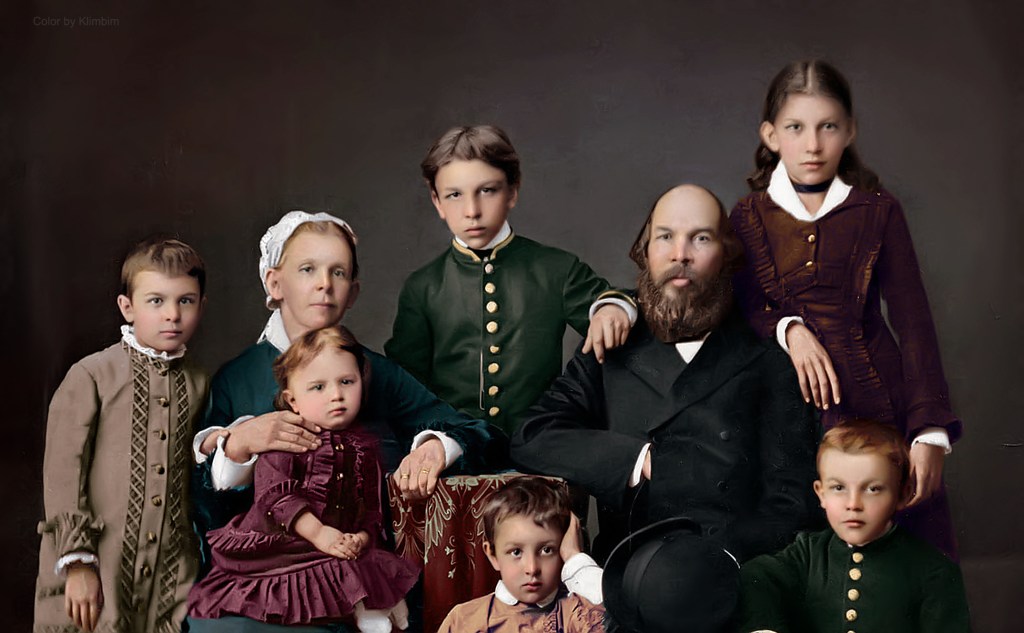
It’s been 100 years since the world lost the revolutionary titan Vladimir Ilyich Ulyanov, more commonly known as Vladimir Lenin. There have been mountains of books, articles, documentaries, and discourse surrounding his legacy, but what’s the real story of his life? What did Lenin think, feel, and do in his life that cemented him as a cornerstone of socialist and communist thought? Lenin is a unifying figure among most of the communist schools—Marxist-Leninists, Trotskyists, Maoists, and more all uphold Lenin. Over a billion people worldwide, especially in the global south, uplift his legacy, and millions of capitalists in the imperial core still treat his specter as a boogeyman.
Lenin was born on April 22, 1870 in Simbirsk, now named Ulyanovsk in his honor in the Russian Empire. Tsarist Russia remained a semi-feudalist society despite the liberation of Russian serfs in 1861. The economic collapse after the defeat in the Crimean War in 1853-6 led to some liberalization of the colonial empire or “prison of nations” as Joseph Stalin called it. “The numerous non-Russian nationalities were entirely devoid of rights and were subjected to constant insult and humiliation of every kind. The tsarist government taught the Russian population to look down upon the native peoples of the national regions as an inferior race, officially referred to them as inorodtsi (aliens)…The tsarist government deliberately fanned national discord, instigated one nation against another, engineered Jewish pogroms, and, in Transcaucasia, incited Tatars and Armenians to massacre each other,” continued Stalin. The backward economy was seen as a barrier to success in modern wars. Russia’s lack of industrialization and capital was a significant issue for the ruling aristocratic class as the age of modern capitalist imperialism was approaching. The overwhelming majority of the population were peasants and the tradition under the feudal system was that peasants—serfs—were “not very different from slaves,” writes Walter Rodney. They are tied to small plots of land while paying rent to the local lord. So while a lord couldn’t sell and buy serfs directly, they could buy or sell the land that the serfs were tied to.
Under the Corvée System as Lenin said, “the entire land of a given unit of agrarian economy, i.e., of a given estate, was divided into the lord’s and the peasants’ land; the latter was distributed in allotments among the peasants, who (receiving other means of production in addition, as for example, timber, sometimes cattle, etc.) cultivated it with their own labor and their own implements, and obtained their livelihood from it…The feudal estate had to constitute a self-sufficing, self-contained entity, in very slight contact with the outside world. The production of grain by the landlords for sale, which developed particularly in the latter period of the existence of serfdom, was already a harbinger of the collapse of the old regime. Secondly, such an economy required that the direct producer be allotted the means of production in general, and land in particular; moreover, that he be tied to the land, since otherwise the landlord was not assured of hands. Hence, the methods of obtaining the surplus product under Corvée and under a capitalist economy are diametrically opposite: the former is based on the producer being provided with land, the latter on the producer being dispossessed of the land.” After the abolition of serfdom, the aristocratic and slowly growing bourgeois classes now owned half of all the land in Russia. The peasants in effect owned less land after the abolition of serfdom, and between 1861 and 1905 the average size of the peasants holding diminished by one-third.
During this period of primitive accumulation, a growing number of peasants became landless and subject to proletarianization—even in agrarian circumstances. For their respective allotments of land, peasants had to pay a “redemption” charge to the government that was, offensively, named the same as the commutation fee for them under serfdom. As Lenin wrote in The Development of Capitalism in Russia, “Thus one cannot conceive of capitalism without an increase in the commercial and industrial population at the expense of the agricultural population, and everybody knows that this phenomenon is revealed in the most clear-cut fashion in all capitalist countries.” The stain of feudalism and serfdom were thus not erased in this liberalizing period.
Because of the ruling classes’ seizure of land, overpopulation in the rural areas became an issue. It was estimated by the time of the 1917 revolution that the rural areas were overpopulated by 20 million inhabitants. This atmosphere, similar to other cases of primitive rural accumulation, leads to greater urbanization. Also, starting in 1886 landlords and employers could fire workers without notice for any cause including “rudeness.” Lenin commented on this urbanization and proletarianization of the rural peasants; “It was seen that the peasantry have been splitting up at enormous speed into a numerically small but economically strong rural bourgeoisie and a rural proletariat.” From 1865-1890 the number of workers in large factories, mills, and railways increased from 706,000 to 1,433,000—the working class more than doubled.
Even though there was a growing capitalist class in Tsarist Russia during the late 19th century, the increase in capital was almost entirely financed and owned by foreign capital. British, French, German, and US capitalists—whom Walter Rodney said had a “colonial relationship” with Russia—were the primary investors and owners of the emerging industrial sectors. The big power stations, railways, oil, and 90% of the mining industries were owned by the foreign bourgeoisie. The Tsarist Empire could also be called the first “genuine” police state in history. It was a volatile and changing class dynamic that the young Lenin grew up within.
He was born to two educated and enlightened parents. His father was a former teacher and Inspector of Elementary Schools, and it was common for the Ulyanov family to have “French Days” for example where every member of the family had to speak that language. There was a certain level of status the family had for a period of time. But even in those days, the work his father did with native ethnic groups in regard to education was revolutionary and counterintuitive to a family of that status. As Maria Prilezhayeva wrote in her biography of Lenin, he would have several early encounters with class struggle, and the insightful and inquisitive minds of his father and older brother Alexandr Ulyanov, or “Sasha” as he was affectionately called, pushed the young child Lenin to be critical of the oppressive and exploitive world around him.
In early January 1886, Lenin’s father suddenly passed away in their home with Lenin present. This was devastating enough, but tragically, horrible events kept happening in his young life. The following year in 1887, Lenin was told at school to go home immediately to his mother for urgent news. When he arrived home, his mother was waiting for him, pale as snow. The letter in her hand was from St. Petersburg. It detailed the news that his older brother whom he had looked up to his whole life, Sasha, had attempted to assassinate Tsar Alexander III. His sister, who also was in the capitol for the university, was arrested under suspicion. A few months later as Lenin was heading to school for his final exams, notices were posted around the city spreading news that Sasha and the other conspirators were executed. His sister was eventually released with no evidence of her involvement. He was greeted in the exam room with silence but was the first to finish. The headmaster of his school was the father of Alexander Kerensky, whose bourgeois government was overthrown by the October Revolution decades later. Lenin’s family was completely ostracized from the community and after graduating from grammar school they left for the city of Kazan so Lenin could attend university there.
Later in life, Lenin told his wife that he had disdain for those “liberal” family friends that abandoned his mother who was a widow, and the entire family due to Sasha. At Kazan University, he told fellow students he wanted to become a professional revolutionary, started to read Sasha’s copy of Capital by Karl Marx, and joined an underground Marxist discussion group in Kazan. At the age of eighteen, he would spend time around Kazan with the workers and peasants, learning about their struggles. Lenin would be one of the leaders of a student protest. News had reached the students in Kazan about a student riot in Moscow and they decided to act in solidarity. As a result of this act of resistance, Lenin was arrested and banished to the remote village of Kokushino. From that point on he would be under constant police threat and surveillance. In his term of exile during the harsh winter, he spent his time reading the likes of revolutionaries Chernyshevsky and other Russian writers. This time of reflection steeled him to the revolutionary struggle, especially for the peasantry as he saw them as the most exploited class in the Tsarist Empire.
After his return from exile, Lenin was refused admission into Law school, and so learned the entire curriculum on his own—completing the four-year course in just a year and a half. He would pass the bar exam with honors as well. Unfortunately, the Ulyanov family continued to suffer tragedy—his sister Olga passed away from typhoid fever in 1891, four years to the day from the execution of Sasha. Lenin would spend some time in the city of Samara as a trial lawyer for local peasants and poor working-class people. In 1893, Lenin would set off to St. Petersburg by himself—with a plan to build a revolutionary mass movement.


Leave a Reply