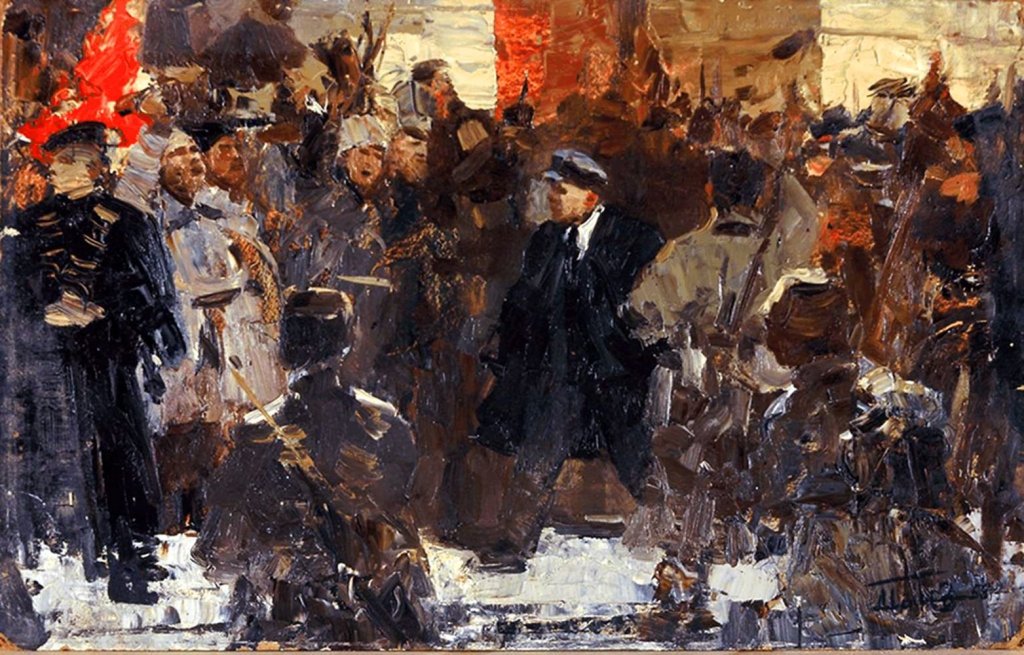
In the early years of the turn of the century, it wasn’t just internal party struggle that was stirring the revolutionary movement in Tsarist Russia, massive class unrest was exponentially growing. St. Petersburg was the epicenter of working class unrest from the mid-1890s, and it rapidly expanded across the empire. Data from the period for how many times the army was deployed to put down strikes and unrest is clear: 19 in 1893, 33 in 1900, 271 in 1901, and 522 in 1902. Between 1800-1854 there were 35 years of famine, and in 1891-1910, there were 13 years of famine. As aforementioned, the growing working class was met with ever-growing class antagonisms and worsening material conditions. Lenin and the split Russian Social Democrats were also not the only group to form in these pivotal years. The Socialist Revolutionary Party (SR) would form and launch a terroristic and Blanquist campaign by assassinating government officials and bombing municipal buildings. Then the imperial regime decided a war with the rising imperial threat of Japan was vital to secure eastern Russia and Manchuria despite the internal issues bubbling to the surface.
Disputes over Korea and a buffer zone of influence between the two empires led to full hostilities with the Japanese attack on Port Arthur, modern-day Lüshunkou, China. The infamous battle started on August 1, 1904, and lasted until January 2, 1905—with many other major Russian defeats in that time as well. The war was going disastrously for the Tsarist regime, and Tsar Nicholas II stubbornly decided to keep it going even after Japan offered numerous times for a mediated armistice. This had a compounding effect on the class struggle in the empire that was present for decades.
The autocratic corruption of the Tsarist regime was being demonized by practically every class besides the aristocracy. Its inefficiency and lack of reforms were creating a tornado of unrest and radicalization. In December 1904, a mass strike in Baku, the oil production hub of the empire, was successful with a particular Bolshevik being a key organizer, Ioseb Besarionis dze Jughashvili, more commonly known as Joseph Stalin. This quickly spread to St. Petersburg in January 1905 as a general strike. After three workers were fired at the Putilov Plant, protests spread throughout the city. Within a day 360 factories had shut down due to strikes. On that fateful January 22, a mass protest was organized by a “half welfare worker and half police spy,” Father Gapon. Its goal was to march on the Winter Palace and demand a constitution and redress for grievances. The masses were then fired on by the military and police. Cossack calvary charged into the crowd. Over 1,000 people are believed to have been killed in the onslaught for what would be called, “Bloody Sunday.” It was the same day that news would reach St. Petersburg of Port Arthur falling to the Japanese. Lenin prophetically wrote in the week prior that it was a “blow struck at the whole of reactionary Europe…It was the Russian autocracy and not the Russian people that started this colonial war, which has turned into a war between the old and the new bourgeois worlds. It is the autocratic regime and not the Russian people that has suffered ignoble defeat. The Russian people has gained from the defeat of the autocracy. The capitulation of Port Arthur is the prologue to the capitulation of tsarism.”
The masses in rallies, and even economic strikes, before Bloody Sunday were commonly led by religious figures, liberals, etc. It was always the people believing if they just showed the Tsar they were suffering, the Tsar would, in all his grandeur, help them. The Bolsheviks ahead of Bloody Sunday in St. Petersburg had warned the workers not to go—that it was dangerous and the Tsar would not listen to peaceful demonstrations. After Bloody Sunday, the masses were radicalized and revolutionary. They had lost hope in the Tsar being their savior. The blood-soaked snow in St. Petersburg could not be forgotten, and the many men, women, and children who were murdered by the regime were now martyrs. Barricades were set up all over the city by the people in response to ready for war. A revolution had begun.
Lenin and the exiled Bolsheviks in Geneva all gathered at the community dining hall run by the Lepeshinsky family. It was a common meeting place for the radical Russian diaspora. The Geneva papers were rushed into the hall. The weight of the movement hung in the air. There wasn’t much discussion at first. Most sat in silence as they started to understand how everything now changed. Someone started to sing the workers’ funeral march, “A Victim of Dire Bondage” with everyone quickly joining in. Lenin proclaimed, “A Revolution has begun in Russia,” and thought to himself, “We must get back home as soon as possible.”
Internal party issues had still gripped the Social Democrats to the point of them being largely caught off guard by the news. The Mensheviks had taken control of Iskra so the Bolsheviks started Vperyod (Forward). Lenin’s words in that first article after the news:
“The working class, which would seem to have stood aside for a long time from the bourgeois opposition movement, has raised its voice. With incredible speed the broad masses of the workers have caught up with their advanced comrades, the class-conscious Social-Democrats. The workers’ movement in St. Petersburg these days has made gigantic strides. Economic demands are giving way to political demands. The strike is turning into a general strike and it has led to an unheard-of colossal demonstration; the prestige of the tsarist name has been ruined for good. The uprising has begun. Force against force. Street fighting is raging, barricades are being thrown up, rifles are crackling, guns are roaring. Rivers of blood are flowing, the civil war for freedom is blazing up. Moscow and the South, the Caucasus and Poland are ready to join the proletariat of St. Petersburg. The slogan of the workers has become: Death or freedom! Today and tomorrow a great deal will be decided. The situation changes with every hour. The telegraph brings breath-taking news, and all words now seem feeble in comparison with the events we are living through. Everyone must be ready to do his duty as a revolutionary and as a Social-Democrat.
Long live the revolution!
Long live the insurgent proletariat!”
The Bloody Sunday protest and many of the early actions taken by the growing uprising grew out of the “Zubatov movement.” These were unions started by Sergei Zubatov, a police administrator, and were entirely controlled by the police. Father Gapon himself was a part of the Zubatov movement and was later assassinated by the Social Revolutionaries. Lenin even went as far as to claim the Zubatov movement was orchestrated by the Tsarist regime to give an excuse to bring in the military to crack down on the rising St. Petersburg working class. “The proletariat has risen against tsarism. The proletariat was driven to revolt by the government. There can hardly be any doubt now that the government deliberately allowed the strike movement to develop and a wide demonstration to be started more or less without hindrance in order to bring matters to a point where military force could be used. Its manoeuvre was successful. Thousands of killed and wounded—such is the toll of Bloody Sunday…” Regardless of the Tsarist’s alleged ulterior motives or designs, the situation rapidly grew out of hand. Uprisings spread within days all throughout the empire. Military arsenals were taken, and the workers and peasants were spontaneously organized and rising up. Within just 4 days strikes and unrest were as far as Baku, Keiv, Sevastopol, and every major city in the western parts of the empire.
“The revolution is spreading. The government is beginning to lose its head…Only an armed people can be the real bulwark of popular liberty. The sooner the proletariat succeeds in arming, and the longer it holds its fighting positions as striker and revolutionary, the sooner will the army begin to waver; more and more soldiers will at last begin to realise what they are doing and they will join sides with the people against the fiends, against the tyrant, against the murderers of defenceless workers and of their wives and children. No matter what the outcome of the present uprising in St. Petersburg may be, it will, in any case, be the first step to a wider, more conscious, better organised uprising…The immediate arming of the workers and of all citizens in general, the preparation and organisation of the revolutionary forces for overthrowing the government authorities and institutions—this is the practical basis on which revolutionaries of every variety can and must unite to strike the common blow.”
Along with the strikes in the big cities, throughout the year there were peasant revolts sporadically everywhere, and in June the prize battleship Potemkin mutinied for the revolution. The autocracy was petrified, so they signed a humiliating peace deal with Japan hoping to move the military forces tied up with the war inward on their own people. The younger generation of revolutionary exiles was desperate to return to the revolution. Lenin was a part of this group being only around 35 years old. After February, the Menshevik at the time Leon Trotsky would return to St. Peterburg and be an influential figure in building the St. Petersburg Soviet in October. Rising Bolshevik leader Joseph Stalin would be a central organizer in the Caucuses. However, until October, Lenin would stay in Geneva mainly and work on building the Social Democratic movement and his journalistic work.
The Third Party Congress was held in April during the first year of the revolution. Lenin was sincere in trying to bridge these divides between party circles, between the Bolsheviks and Mensheviks. The “rank and file” party members were overwhelmingly on the Bolshevik’s side due to the perceived good-will attempts to eliminate inter-party discourse, and the Menshevik’s refusal to participate in the Third Party Congress. Lenin was clear about the recent party split, it’s causes and effects:
“To achieve this great aim we must unite all class-conscious proletarians in a single Russian Social-Democratic Labour Party. Our Party began to constitute itself quite some time ago, immediately following the broad working-class movement of 1895 and 1896. The year 1898 saw the convocation of its First Congress, which founded the Russian Social-Democratic Labour Party and outlined its aims. The Second Congress was held in 1903. It gave the Party a programme, adopted a series of resolutions on tactics, and endeavoured, for the first time, to build an integral Party organisation. True, the Party did not at once succeed in this effort. The minority at the Second Congress refused to submit to the majority and started a split that has caused great harm to the Social-Democratic working-class movement. The first step towards this split was the refusal to carry out the decisions of the Second Congress and to accept the leadership of the central bodies it had set up. The last step was the refusal to participate in the Third Congress. The Third Congress was convened by a Bureau elected by the majority of the committees working in Russia, and by the Central Committee of the Party. All the committees, breakaway groups, and the periphery organisations dissatisfied with the committees were invited to the Congress. The vast majority of these organisations, including nearly all the committees and organisations of the Minority, elected delegates and sent them abroad to attend the Congress. Thus everything possible under our police regime was done to convene an all-Party congress; it was only the refusal of three members of the former Party Council resident abroad that resulted in the boycott of the Congress by the entire Party Minority.
Nevertheless, despite the absence of the Minority, the Third Congress took every measure to enable the Minority to work with the Majority in one party. The Congress held the reversion to the antiquated and superseded views of Economism discernible in our Party to be incorrect; at the same time, it provided precise and definite guarantees of the rights of every minority, guarantees embodied in the Rules of the Party and binding on all its members. The Minority now has the unconditional right, guaranteed by the Party Rules, to advocate its views and to carry on an ideological struggle. so long as the disputes and differences do not lead to disorganisation, so long as they do not impede constructive work, split our forces, or hinder the concerted struggle against the autocracy and the capitalists. The right to publish Party literature is now granted by the Rules to every qualified Party organisation. It has now been made incumbent on the C.C. of the Party to transport all kinds of Party literature upon the demand of five qualified committees, or one-sixth of all such committees in the Party. The autonomy of the committees has been defined more precisely and their membership declared inviolable, which means that the C.C. no longer has the right to remove members from local committees or to appoint new members without the consent of the committees themselves. This rule admits of only one exception, namely, in cases where two-thirds of the organised workers demand the removal of a committee; under the Rules adopted by the Third Congress such removal is incumbent on the C.C. if two-thirds of its members agree with the decision of the workers. Every local committee has been accorded the right to con firm periphery organisations as Party organisations. The periphery organisations have been accorded the right to nominate candidates for committee membership. The boundaries of the Party have been defined more precisely, in accordance with the wishes of the Party majority. A single centre has been set up instead of two or three. The comrades working in Russia have been guaranteed a decided preponderance over the Party’s section abroad. In a word, the Third Congress has done everything to remove all possibility of charging the Majority with abuse of numerical superiority, with mechanical suppression, with despotism of the central bodies of the Party, and so on and so forth.”
Lenin wrote before the Congress in an article Time to Call a Halt and an Open Letter to Comrade Plekhanov , that Plekhanov had capitulated to “revisionist” and “anarchists-individualists” within the party, and that the Mensheviks had disrupted local party work within Russia ahead of the revolution and the party congress. The “party crisis” had “grown to such dimensions” that the RSDLP was brought to a “standstill.” And even though there was dissension based on tactics and organization—“more often than [not],” the disputes were because one side was Menshevik versus the other side being Bolshevik. Out of the 75 votes that would be representative at the Party Congress, 52 voted in favor, yet Plekhanov and the Mensheviks controlling the Party Council refused to participate. Thus, the Third Party Congress elected a new central committee, all Bolsheviks—Lenin, Bogdanov, Krasin, Postalovsky, and Rykov. They officially closed Iskra and Vperyod (Forward) as the dual disputing party papers for the Proletary (Proletariat). Lenin would again call for “unity” with the Mensheviks, “We are in agreement with you over nine-tenths of the questions of theory and tactics, and to quarrel over one-tenth is not worthwhile.”
The reality is though, regardless of Lenin’s seemingly good-will intentions to unite the RSDLP, that “one-tenth” of disagreement between the Bolsheviks and Mensheviks was a wide and deep chasm between the two. Lenin’s clarity on the actuality of revolution and the concrete analysis based on the concrete material conditions of his time set him apart, and that would be for the first time materially clear in this historical record of the 1905-1907 revolution. It would develop into a world-altering movement in 1917. Lenin and the Bolsheviks faced the questions of the revolution of 1905 with crystal clear analysis—the need for a militant party of the proletariat to mobilize and organize the mass class struggle beyond purely economic struggles and strikes. The actuality of the revolution was here, and the Mensheviks fell behind due to their criticism of the armed struggle especially after the enacting of the State Duma. During a revolution, to not side with the masses of people uprising is to be counter-revolutionary, and that is the issue with the Mensheviks during this time.
Fundamentally the Mensheviks, along with the rest of the international socialist movement could not perceive a revolution where the proletariat wasn’t the only revolutionary class. Lenin and the Bolsheviks saw clearly that the majority of the population were semi-serfs, and they had amassed revolutionary potential due to the generational oppression they had been facing. Even Karl Kautsky, the pseudo-heir to Marx and Engels and the ‘recognized’ principled Marxist compared to Eduard Bernstein thought the urban proletariat should be neutral in the revolution. This dogmatic interpretation of Marxism would plague the Western communist movement. It was taking historical documents written by Marx and Engels and attempting to overlay that to a different time and material conditions, and for such seasoned theorists, a grave error against dialectical materialism. Nadya in her biography of her husband, “Reminiscences of Lenin” wrote how Lenin took this critique from Kautsky and others seriously. He dived back into Marx and Engel’s work on the agrarian issue and in Lenin’s article “Marx on the American Redistribution” stated, “There is hardly another country in the world where the peasantry is experiencing such suffering, such oppression and degradation as in Russia. The more dismal this oppression of the peasantry has been, the more powerful will now be its awakening, the more invincible its revolutionary onslaught. It is the business of the class-conscious revolutionary proletariat to support this onslaught with all its might…” The Mensheviks themselves became split when Leon Trotsky and Alexander Parvus formed a separate faction, who were for an armed revolution, but purely of the workers—the urban proletariat. There was still a complete disregard for the vast majority of the people—the peasantry.
During the spring, summer, and early fall of 1905 the revolution was sporadic, unorganized, but continuous. The first form of dual power in Russia was created during this time with the worker’s councils, or Soviets. First in May in the city of Ivanovo, then Kostroma, and Moscow in September. It would set the stage for the autumn and winter revolutionary explosion. Lenin was still in Geneva, Switzerland until the autumn but diligently stayed up to date. He would even make efforts to meet with Father Gapon—who led the initial St. Petersburg strike during Bloody Sunday—and revolutionaries from the battleship Potemkin and throughout the Tsarist empire. The battleship Potemkin famously led a mutiny and sided with the revolution before surrendering, but it inspired the masses and foreshadowed to events of 1917. In September, the Tsarist Empire was forced to sign an embarrassing peace treaty with rising imperial power Japan—hoping this would de-escalate the unrest throughout the empire.
October, everything escalated. A strike wave broke out in Moscow, and by October 7th had spread to St. Petersburg for a full-on General Strike. Workers called for civil liberties, eight eight-hour work days, amnesty for revolutionary activities, and a Constituent Assembly. Initially, the telegraph workers didn’t want to participate so other workers cut the wires, uprooted poles, tore up railroad tracks, and blockaded key nodes of transportation. By October 12, the entire city was at a standstill and then unrest spread throughout the country when 750,000 railroad workers went on strike too. Some forty cities were affected or had their own general strikes such as Moscow, Kharkov, and Reval—and barricades were set up in Kharkov, Odessa, and other cities with open street fighting between workers and Tsarist forces. The entire economic and social life of the empire was halted by the rising tide of the masses. Lenin wrote in October, “One thing is certain: before our very eyes, the insurrection is spreading, the struggle is becoming ever more widespread, and its forms ever more acute. All over Russia the proletariat is pressing onward with heroic efforts, indicating now here, now there, in what direction the armed uprising can and, undoubtedly, will develop…The civil war has assumed the form of desperately stubborn and universal guerilla warfare.” The forces of reaction and autocracy had to yield from the pressure—in a way.
Eventually Tsar Nicholas II, with the help of soon-to-be prime minister Sergei Witte, made certain concessions. Under the October Manifesto from the Tsar, a semi-constitution and pseudo-representational body called the State Duma were promises made by the autocracy. The Duma would have two houses—the upper house appointed directly by the Tsar—lower house elected by the bourgeois and aristocratic classes. It had no real material power and was controlled by the ruling classes. It was only to meet for 1-2 months out of the year as well. These concessions had a blowback effect—instead of the people seeing this as the ultimate win—they say it was a sign of the ruling classes on the retreat. Around this time, on October 26, the first Soviet Workers’ Deputies of St. Petersburg meet at the Institute of Technology. At first, it was only 30-40 delegates representing unions and workers were present. It only existed for fifty days but it eventually grew to nearly 600 delegates representing 147 factories, 34 workshops, and 16 unions. It was a direct example of a dual power structure being created in a revolutionary period. It organized the masses for strikes, demonstrations, armed struggle, and for community defense against Black Hundred programs and Tsarist aggression. It was the embryo, born organically by the direct mass struggle of the people, of a revolutionary government—echoing the history of the Paris Commune of 1871. The Soviets allowed three delegates from the Bolsheviks, Mensheviks, and the Social Revolutionaries with a voice in the discussions and votes in decision-making for the Soviets. It had no paid bureaucracy and because it wasn’t concerned with contending classes, was not a dual chamber parliamentary institution to try to appease a ruling capitalist class. Lenin and the Bolsheviks viewed the Soviet not just as a parliamentary body for workers, but as a true revolutionary dual-power structure created to replace bourgeois parliamentism by the direct seizure of power. After two months of agitation and ultimately leadership by Trotsky, most of the Soviet leadership in St. Petersburg was arrested. However, other Soviet Worker’s Deputies would spring up across the empire in a winter revolutionary bloom.
October, November, and December of 1905 saw the greatest increase in revolutionary activity and state violence of the uprising. Over 4,000 people were murdered by the state in 100 cities, with more than 10,000 more injured. Black Hundreds, a proto-fascist and pro-monarchist group organized pogroms against Jewish people, workers, and students. The Soviets and workers parties organized militias to combat them and the state. The uprising spread to Poland, which was under the control of the Tsar at the time, and it intensified in the countryside with the peasantry and colonized nations. Massive spontaneous strikes, boycotts, refusal to pay taxes, seizing and redistribution of property and basic necessities, and even destruction of landlord property—about 2,000 lordly manors and estates were destroyed (which would be $3.3 trillion dollars in damages in today’s US dollar worth). While Marxist propaganda and agitation certainly influenced the urban proletariat radicalization and organization—Trotsky himself along with several other Mensheviks and Bolsheviks were active members of the St. Petersburg Soviet—the peasantry and colonized people of the imperial periphery were acting out of generational trauma—unguided and unorganized. There was an attempt to organize the peasants more with the creation of the Peasants Union, but the leadership in Moscow was arrested. The Ministry of the Interior declared the peasant revolts had to be put down. It was in this rapid shift in the struggle from general strikes to armed struggles in urban, as well as rural areas, Lenin would finally return to Russia.
Lenin and Nadya returned to St. Petersburg as many of the young revolutionaries did around the time of the October Manifesto which in theory opened up some forms of legal class struggle. He waited in Stockholm, Sweden, for a contact to give him fake documentation and alias to enter Russia—the contact never came and eventually Lenin smuggled his way into St. Petersburg—Nadya joining a couple weeks later. At first, they lived separately and were undocumented. Nadya writes that the “moment” they did get proper documentation their residence was perpetually spied on by the Tsarist police. Eventually, they would move to Finland in hiding as the Tsarist regime’s reach in that area was limited due to the revolution in other areas. Lenin would travel to Moscow and other areas to clandestinely organize the Bolsheviks as well. His participation in revolutionary activities in the 1905 revolution, and eventually the October Revolution of 1917, has been scrutinized. This narrative is even carried by fellow Marxists. British Marxist historian Christopher Hill describes Lenin as, “taking little public part in revolutionary activities, but extremely active as a publicist and behind the scenes. With the defeat of the revolution Lenin withdrew to Finland, and finally left Russia…” But this tells really half the story. As previously mentioned and confirmed by Nadya, Lenin was under secrecy traveling quite some distance in the middle of a heightened period to direct revolutionary activity. He was in Moscow in December before a massive general strike rocked the city and the Moscow Soviet Workers’ Deputy was established—this time with a Bolshevik majority. Bourgeois historian Christopher Read said Lenin was, “actively involved in the struggle in Russia…minor but active role in organizing street action and supporting armed uprising.” Lenin would speak at the Soviet in St. Petersburg before it was dissolved as well. Even before coming back to Russia, Lenin organized shipments of weapons to revolutionary forces. So, the perception that Lenin was just writing about revolutionary activities, and not actively participating in them is just unfounded.
The party was growing rapidly enough that the Bolsheviks started a daily paper to accompany the Proletary, the Novaya Zhizn (New Life). Lenin would use these platforms to analyze the revolution and balance of forces in the class struggle. The Bolsheviks and Mensheviks vehemently disagreed on the role of a socialist party regarding electoral participation and armed struggle—before and after the enacting of the State Duma and the formation of the Soviets. There aren’t many surviving works from Menshevik leaders like those from Lenin and other notable Bolsheviks—a victim of losing the factional war. However, Julius Martov, one of the leading Menshevik figures of the era wrote in 1907 in The Lessons of the Events in Russia with a hyper-focus on the “legal” side of the struggle. In a time when the revolution was all but over, perfect for reflection on why the armed revolution failed, Martov spends little or no time writing on the need to increase the military capacity of the working class and social democrats. No effort from Martov to explain how to train and equip working-class militias to not only hold cities for weeks but to gain political and economic power.
It must also be noted that before the October Manifesto and the creation of the State Duma, certain liberal and bourgeois factions were on the side of the revolution—such as the Cadets. Once October happens, the bourgeoisie returns to the side of the Tsar and against the working and peasant classes. In a dogmatic view of Marxism and class struggle—where society goes through distinct stages of ancient slave-owning, feudal, bourgeois, and then socialist societies—the revolution is over after October. The effort, in a dogmatic Marxist view which the Mensheviks were a victim of, to get the semi-feudal Tsarist society to socialist and a dictatorship of the proletariat was impossible. It had to go through those distinct and universal stages. Lenin and the Bolsheviks rejected that and adapted to their material conditions. Marx and Engels rejected any attempts to dogmatically take their works and transpose them incorrectly to a different time with a different set of material conditions. A more modern and renowned Marxist theorist, Walter Rodney, summed up this phenomena, “Marxism can only be of value if whatever it takes to be the universal is applied to the particular; and it is in the very particularity of the exercise that one will demonstrate that the universal is actually universal and that it is applicable.” Lenin clearly saw—due to the semi-feudal stage of development of Russia—that the “revolutionary people” were the working class and peasantry. The dictatorship of the proletariat that Marx and Engels wrote about when concerning capitalist-developed western Europe, was expanded upon when looking outside those material conditions with the “revolutionary dictatorship of the proletariat and peasantry.”
Lenin in Two Tactics of Social-Democracy in the Democratic Revolution explained the differences in strategy and tactics between the Bolsheviks and Mensheviks. He dismissed their “tactics-as-a-process” that was rigid and non-dialectical. While the Mensheviks sought only parliamentary and bourgeoisie tailist policies because of the stagism they prescribed, Lenin stated, “The difference between us in this respect is that we march side by side with the revolutionary and republican bourgeoisie, without merging with it, whereas you march side by side with the liberal and the monarchist bourgeoisie…” He continued, “They failed to take into consideration that in a period in which a revolution has begun, when there is no parliament, when there is civil war, when insurrectionary outbreaks occur, the concepts and terms of parliamentary struggle are changed and transformed into their opposites…our admirers of Martynov repeat the lessons of peaceful parliamentarism just at a time when, as they themselves state, actual hostilities have commenced…A Social-Democrat must never for a moment forget that the proletariat will inevitably have to wage the class struggle for Socialism even against the most democratic and republican bourgeoisie and petty bourgeoisie.”
At the end of December, the Bolsheviks decided to hold their own party congress in Finland and Sweden called the Tammerfors Conference—though there was a Menshevik representative named E.L. Gurevich. Its congress minutes have unfortunately been lost to time but certain details are well known. Nadya describes the atmosphere of the Conference as “enthusiasm…reigned there,” because the “revolution was in full swing.” It was the first time Lenin and Stalin met in person as well. They had been writing to each other privately since 1903 and Stalin idolized him since the 1890s. It’s quite comical when Stalin gives a speech decades later on this meeting stating,
“I had pictured Lenin as a giant, stately and imposing. What, then, was my disappointment to see a most ordinary-looking man, below average height, in no way, literally in no way, distinguishable from ordinary mortals…It is accepted as the usual thing for a “great man” to come late to meetings so that the assembly may await, his appearance with bated breath; and then, just before the “great man” enters, the warning whisper goes up: “Hush! . . . Silence! . . . he’s coming.” This ritual did not seem to me superfluous, because it creates an impression, inspires respect. What, then, was my disappointment to learn that Lenin had arrived at the conference before the delegates, had settled himself somewhere in a corner, and was unassumingly carrying on a conversation, a most ordinary conversation with the most ordinary delegates at the conference. I will not conceal from you that at that time this seemed to me to be something of a violation of certain essential rules. Only later did I realise that this simplicity and modesty, this striving to remain unobserved, or, at least, not to make himself conspicuous and not to emphasise his high position, this feature was one of Lenin’s strongest points as the new leader of the new masses, of the simple and ordinary masses of the “rank and file” of humanity.”
The Bolsheviks approved of the merging and unity of the two factions of the RSDLP, a call for a unity congress, furthered the agrarian question and called for the confiscation of all landed estates and church property, a boycott of the first Duma (which Lenin objected to but was outvoted), further democratic centralism, and “preparation and organization of an armed uprising.” As the conference was going on, a new wave of the revolution started in Moscow and the conference had to be ended early.
The Moscow uprising, the Bolshevik-majority Soviet, and the de facto control of the entire city for almost two weeks shook not only the empire, but the revolution as well. The events of the Moscow uprising were quite similar to the events of October—a strike wave hit the city, and the Tsar sent in detachments of troops to put down the strikes to not have a repeat of October. Armed worker militias were quickly organized, set up barricades throughout the city, and held the city for ten days. The Tsar sent in infantry, heavy artillery, and Cossack calvary and laid siege to Moscow, particularly the Presyna district where many of the factories were and where the Bolshevik-led Soviet was located. However, there was a limited amount of organization for the fighting and a severe manpower issue for the revolutionary fighting force. Out of the nearly 150,000 workers who started the strike wave in Moscow, only 1,500 were actively fighting on the barricades when the Tsarist reaction arrived. The leadership was ill-prepared for the immediacy of the strike-to-revolution transition which exploded with a bombing of a police station. After the Tsarist regime stamped out this revolutionary fire, at least 1059 people were killed—137 women and 86 children—and 510 people were arrested and sent to the gulags.
In Lessons of the Moscow Uprising, Lenin saw that the “mass proletarian struggle developed from a strike to an uprising.” The struggle had reached again a new “higher stage” through the “enormous sacrifices” of the working class of Moscow. He saw that even though the Moscow uprising was put down, it wasn’t a mistake of the people to take arms. The mistakes and lessons were in “tactics and organization…military tactics…tactics of guerrilla warfare…” The idea of “small” and “mobile” units striking the enemy and regrouping for continual harassment. The “new barricade tactics” to turn a city into a guerrilla fortress. All of these were advancements in Lenin’s view of the working class struggle in Russia from the age of labor strikes for purely economic gains. The failures were not to “develop” these tactics “far enough…to a really mass extent. There were too few volunteer fighting squads, the slogan of bold attack was not issued to the masses of the workers and they did not apply it; the guerrilla detachments were too uniform in character, their arms and methods were inadequate, their ability to lead the crowd was almost undeveloped.” Lenin also tied in the spontaneous “mass terror” from the peasantry and working class throughout the month and how that with more organized guerrilla warfare will teach the masses, through the struggle, the correct tactics and strategy. That Marxists can’t ignore “mass terror” and “incorporate it into its tactics, organizing and controlling it of course, subordinating it to the interests and conditions of the working class movement.”
Conversely, Plekhanov denounced the Moscow Uprising, “They should not have taken to arms.” Lenin, according to Nadya, “felt the Moscow defeat very keenly.” Plekhanov due to his health and age was not in Russia. He was alienated not only from the revolution but from the very masses of people who were sacrificing their lives for the struggle. That distance and alienation from the struggle leads to deviations and revisionism. Lenin, the Bolsheviks, and even Mensheviks like Trotsky were actively engaging in the struggle with the masses. It would set the road for some conciliatory efforts from certain Mensheviks with the Bolsheviks by 1917.
From 1906-1907, the revolution ebbed and flowed. The Bolsheviks organized underground partisan groups for guerrilla warfare throughout the countryside where the revolutionary fervor was not as exhausted as the urban hubs of the empire. Unlike other revolutions—France and England in particular—the peasantry in Tsarist Russia didn’t side with the reactionary forces. Also, unlike the Paris Commune, the Revolution had spread like wildfire throughout many urban centers and the countryside. In this timeframe, there would be three different Duma’s created. The Tsar would open up semi-compromises for the masses, the masses would continue the revolution, and the Tsar would restrict or shut down the Duma completely, and this was the pattern for the next two years. It was a tumultuous, protracted, and ever-fluid struggle. The Mensheviks kept a static, dogmatic, approach to work purely through the parliamentary struggle and within a bloc with the liberal bourgeois Cadets. The Bolsheviks through this period did have a program that ebbed and flowed with the material conditions and the stage of the struggle at present.
In late April and early May, there was an attempt at a Unity Congress of the RSDLP with both Bolshevik and Menshevik factions present along with every major national organization such as the Jewish Bund again. They fought on issues of democratic centralism, armed struggle, underground partisans, attitude towards the State Duma, the agrarian question, and more. However, it was the formal unification of the party again, with the Bolsheviks ignoring the resolution in the congress about the liquidation of the underground guerrilla units. Those were kept active by the Bolsheviks. This party unity wouldn’t stop Lenin’s sharp criticism of Menshevik’s proposals and theory, and there wasn’t consistent unity between the two factions. During the Second Duma, Bolsheviks were able to form Left Blocs in Moscow and St. Petersburg to win elections, but the Mensheviks only worked in the Left Bloc in Moscow and not St. Petersburg—which went against their programs and showed a pettiness and factional thinking instead of keeping the class struggle as the priority. Nadya calls the atmosphere of the Unity Congress as “factional” but that Lenin “still hoped” the wave of revolutionary activity would unify the factions. He would write to St. Petersburg workers about the congress afterward stating, “Freedom of discussion, unity of action is what we must strive for…All Social-Democrats agree among themselves in Supporting the revolutionary action of the peasantry and criticizing petty-bourgeois utopias…In the elections complete unity of action is imperative. The congress has decided that we should all vote wherever there are any elections. No criticism for taking part in the elections is to be made during the elections. The action of the proletariat must be united.”
In June of 1906 the historic revolutionary contemporary, Rosa Luxemburg, would travel to Russia and worked with Lenin and the Bolsheviks. She was recently released from prison in Tsarist-controlled Warsaw. She would meet and work with Lenin—building a respectful relationship. It will come again when in 1917, Luxemburg would critique the Bolsheviks. It’s often used by left communists and social democrats today as ammunition against the ‘purity’ of the Russian Revolution—even though Rosa Luxemburg would have her own break with Social Democracy in Germany like Lenin in Russia, led a communist revolution that started soviets, but tragically be murdered by an alliance of social democrats and reactionary elements. The irony of today is when the ideological descendants of dogmatic Marxism and social democracy of the Second International denounce Lenin but uplift Rosa Luxemburg.
The First Duma was “legally” dissolved in the summer of 1906 and the Second Duma would be created in early 1907 before also being dissolved and a massive wave of state repression against all political parties that did not align with the autocracy like the Black Hundreds. Which were able to gain—with a right-wing bloc with the Octobrists—a majority within the Third State Duma by the time it was created in early November. At this point, Lenin was clear on the “utter uselessness” of using the Duma to achieve the demands of the workers and peasants. There was an “impossibility of achieving political freedom by parliamentary means as long as the real power remains in the hands of the tsarist government.” The struggle had to be waged in “open struggle” against the forces of “absolutism.” In August 1907, the Second International, the collective body of all the socialist parties in the world—had another congress in Stuggart. Lenin, Stalin, and other Bolsheviks were delegates from the RSDLP. Issues on war, colonialism, trade unionism, etc. were discussed. It was also another time of meeting Rosa Luxemburg, Karl Kautsky, etc., and pushing for a more dialectical approach compared to the revisionist trend by Eduard Bernstein and others.
Due to the continued and increased state repression and the revolutionary movement being exhausted by the end of 1907, a mass exodus of revolutionaries happened again. The parties became illegal again and the forces of reaction had temporarily triumphed. Eventually, even Lenin would have to leave Russia again, thinking he may never see it again, and he almost didn’t. He was supposed to get smuggled from Finland to Sweden and had to cross a massive lake. His contact never showed so he sent out on the frozen lake at night. Lenin according to all sources almost died in that journey to Sweden across a frozen lake. He would later tell Nadya that when he felt the ice give way underneath him he thought to himself, “Ah, what a stupid way to die.” Lenin and Nadya would travel from Stockholm, Sweden to Berlin, Germany. They had to escape police in Berlin who were arresting Russian revolutionaries fleeing Tsarist repression just to face Kaiser oppression. Their saving grace was again, Rosa Luxemburg who hid them before getting them safely back to Geneva Switzerland. The Ulyanovs had returned to a life of diaspora and secret police evasion, but the revolutionary drive was not extinguished.
 Red star tribune
Leave a comment