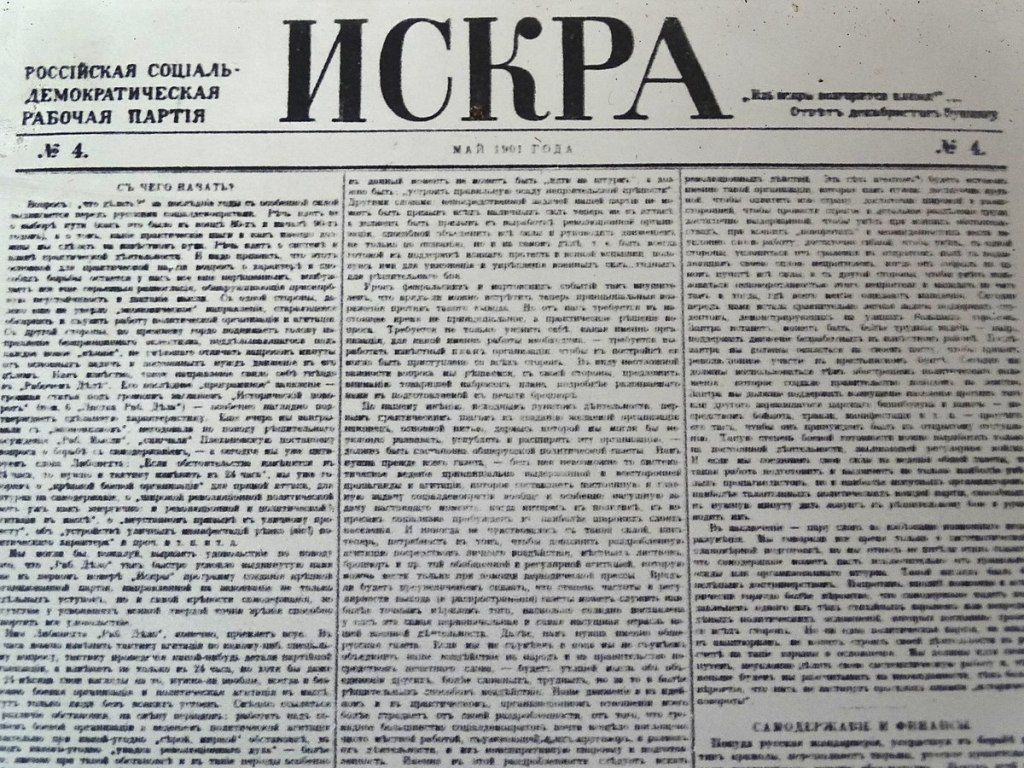
In February 1900, Lenin was finally released from exile in Siberia. He immediately set about creating a clandestine system of distribution for what would become the ideological sword of the Russian Social Democratic Labor Party (RSDLP) for the next five months. The police state apparatus of Tsarist Russia meant the party newspaper would have to be produced abroad and then smuggled into Russia, so Lenin obtained permission to travel abroad supposedly for his health. Nadya still had several months left in exile but would eventually reunite with him abroad.
The name of the newspaper would be Iskra—the Spark—from a line in the poem by a Decembrist, “The spark will kindle the flame.” Lenin thought it was befitting of this new revolutionary party. He eventually found his way to Leipzig, Germany. Where a small print shop owner by the name of Hermann Rau—and member of the German Social Democratic Party—was told by friends that Russian Marxists were in the city and looking for a print shop to make a revolutionary paper. In this small one-press printing shop, the first issue of Iskra was printed. The system of distribution to get Iskra from Germany to “every major city” of Tsarist Russia was vast, secretive, and ultimately truly impressive. Secret meetings and suitcase drop-offs at bars, seaports, etc. were common. Cadres from Germany, Sweden, and Finland—all the way to the Caucuses region where Stalin was the first to smuggle Iskra into the region—were highly effective. This was an illegal paper in the Tsarist Empire—anyone caught with it would be sent to the gulags, in exile, or worse. The operation had to be at a high organizational level in order to fulfill its mission of spreading revolutionary consciousness to the working class.
By 1901, Vladimir Ulyanov began writing under the name “Lenin” for Iskra’s articles and it would be the name the entire world would come to know. In 1902, due to mounting police pressure in Germany, the Iskra editorial board and production moved to England and then Geneva, Switzerland. Lenin became the “guiding spirit” and a significant contributor to Iskra, but it was one of many “circles” as Lenin called them during this time of disunity of the RSDLP. The party’s forming congress was prematurely stopped by the police, so while a Social Democratic Party did exist, there was no unified program, central committee, party organ/newspaper, or party rules. There were many different factions or “circles” in the RSDLP:
-The Iskra (which would eventually be split as well) at the beginning featured the staff of Lenin, Plekhanov, Dimitri Ulyanov (Lenin’s younger brother), Vera Zasulich, Aleksandr Petresov, Pavel Axelrod, Julius Martov, and eventually Leon Trotsky. The latter three would especially lead to the split of the Iskra faction.
-Rabocheye Dyelo was the newspaper of the Union of Russian Social Democats Abroad and was the far-right of the RSDLP.
-Yuzhny Rabochy was the name of an illegal newspaper and a group of Russian social democrats. Represented the center of the party along with the Bund.
-The General Jewish Labour Bund was a Jewish socialist party primarily in western Russia, Poland, and Lithuania.
These were most of the main groups that would be struggling for control of the RSDLP. From 1900-1903 Lenin actively struggled for the ideological spirit of the Russian revolutionary party which he knew was going to hit a climatic moment at the next party congress. He published several key works that led up to that fateful congress of 1903. Several articles, pamphlets, and books on the Agrarian Question such as The Agrarian Question and the “Critics of Marx”, The Workers’ Party and the Peasantry, and To the Rural Poor deal with the material and theoretical breakthrough of the alliance of the working class with the peasantry. “And the peasants, too, will then rise all over Russia and go to the aid of the urban workers, will fight to the end for the freedom of the workers and peasants. The tsar’s hordes will be unable to withstand that onslaught. Victory will go to the working people, and the working class will march along the wide, spacious road to the liberation of all working people from any kind of oppression. The working class will use its freedom to fight for socialism!” Groups like the Rabocheye Dyelo-ists were against unity between these two oppressed classes. These works were also vehicles for Lenin to promote and explain his proposed party program, which would be one of the key dividing conflicts.
Lenin’s other two, and most important works before the Party Congress, were Where to Begin? and What is to Be Done? The former is a “skeleton plan” for the latter as Lenin said. Where to Begin? was published in Iskra in 1901; it was a “question of a system and plan of practical work” for the RSDLP which Lenin admits they had “not yet solved.” There was internal party debate about the organizational structure and foundation of the party, and it was an issue Lenin thought clearly was one of the priorities of the party due to it risking “ideological instability” within the RSDLP. Lenin also attacked the adventurists within the Party who wanted to lead the party on a military path they were not ready for:
“In principle we have never rejected…terror. Terror is one of the forms of military action that may be perfectly suitable and even essential at a definite juncture in the battle, given a definite state of the troops and the existence of definite conditions…Without a central body and with the weakness of local revolutionary organisations, this, in fact, is all that terror can be. We, therefore, declare emphatically that under the present conditions such a means of struggle is inopportune and unsuitable; that it diverts the most active fighters from their real task, the task which is most important from the standpoint of the interests of the movement as a whole; and that it disorganises the forces, not of the government, but of the revolution…But can we issue the call for such a decisive assault at the present moment? Rabocheye Dyelo apparently thinks we can. At any rate, it exclaims: “Form assault columns!” But this, again, is more zeal than reason…”
Due to the fractured ideological trends having their respective newspapers and press outlets, Lenin also called for a single recognized party newspaper because he saw it as a “collective propagandist…collective agitator…[and] collective organizer.” In his next work, and considered one of his best, What is to Be Done? Vladimir saw the growing crises of the Party with the “two trends” that ran opposed to each other in the Social Democratic movement—revolutionary or reformism. It wasn’t just a Russian issue as Lenin correctly observed the trend largely originated from German Social Democrat Eduard Bernstein, “The essence of the “new” trend, which adopts a “critical” attitude towards “obsolete dogmatic” Marxism, has been clearly enough presented by Bernstein and demonstrated by Millerand. Social-Democracy must change from a party of social revolution into a democratic party of social reforms.” Lenin said Bernstein, and the reformist and opportunist line he started “denied” scientific socialism, dialectical and historical materialism, and the dictatorship of the proletariat. This growing denial of basic tenets of Marxism was infecting the more ideologically unstable “circles” within the RSDLP. But this was an inevitable material outcome of the alliance between the “legal Marxists” and the revolutionary Social Democratic group during the previous decades which Lenin attributed this alliance with the win of the Social Democrats over Narodism. This “temporary alliance” was vital to that early era, but was rapidly becoming obsolete as the class struggle was progressing to a new phase of development.
Vladimir Lenin mapped out the history and fallout of this alliance, the importance of organization over “worship of spontaneity,” and added; “Without revolutionary theory there can be no revolutionary movement. This idea cannot be insisted upon too strongly at a time when the fashionable preaching of opportunism goes hand in hand with an infatuation for the narrowest forms of practical activity.” At this point, we wish to state only that the role of vanguard fighter can be fulfilled only by a party that is guided by the most advanced theory.” He showed the reality of the peasant revolts and terroristic acts were” spontaneous” and simply the “resistance of the oppressed.” However, he also believed the systemic strikes within Russia only represented the “class struggle in embryo.” The working class of Tsarist Russia needed “Social-Democratic consciousness,” that had to come “from without” via a revolutionary Social-Democratic party built on the alliance of the proletarian and peasant classes—and that party had to be built on democratic centralism around professional revolutionaries. He called for not just political “education” but also “agitation” against every “concrete example” of “oppression.” Ultimately not to limit the political, economic, and ideological struggle of the oppressed classes, which was different from the view of other “circles” of the RSDLP.
Lenin prophetically said, “The national tasks of Russian Social-Democracy are such as have never confronted any other socialist party in the world. We shall have occasion further on to deal with the political and organisational duties which the task of emancipating the whole people from the yoke of autocracy imposes upon us. The Russian proletariat will have to undergo trials immeasurably graver; it will have to fight a monster compared with which an antisocialist law in a constitutional country seems but a dwarf. History has now confronted us with an immediate task which is the most revolutionary of all the immediate tasks confronting the proletariat of any country. The fulfillment of this task…would make the Russian proletariat the vanguard of the international revolutionary proletariat.”
 Red star tribune
Leave a comment