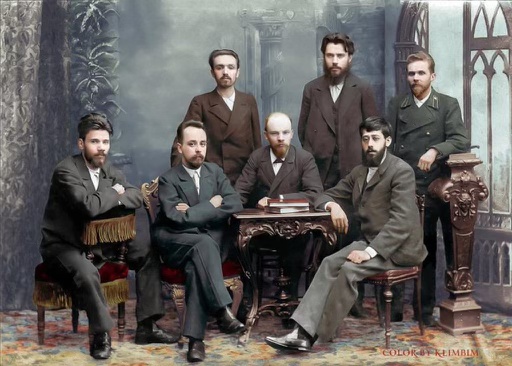
The Marxist movement was still young and had a small influence in Tsarist Russia during Lenin’s early years—even when Lenin was on his way to St. Petersburg to organize the decentralized Marxist groups. By 1893—when Lenin had arrived in St. Petersburg—Germany already had a strong Marxist party in the Social Democrat Party. Russia didn’t have an analog to that strong, organized party. But as previously mentioned, there was a strong history of revolts, terrorist actions against the regime, and an intelligentsia that was becoming more radical and materialist in their philosophical orientation. Intellectuals such as Vissarion Belinsky and Nikolay Chernyshevsky with the Narodniks—along with the growing proletarianization of the Russian peasantry—made fertile ground for Marxist theory to accelerate the growing class struggle.
Three months before Lenin was born in 1870, Karl Marx began his first serious study of Russia. Capital Vol. 1 was first translated from the original German to Russian in 1872 with immediate success and circulation. The first official and documented Marxist circle was in 1883—the Emancipation of Labor Group. Its most prominent figure was Georgi Plekhanov—who still is a revered theorist in Russian Marxism even though he would have serious conflicts with Lenin and the Bolsheviks. Maxim Gorky referred to the conflict between Lenin and Plekhanov: “I have rarely met two people with less in common than G. V. Plekhanov and V. I. Lenin…The one was finishing his work of destroying the old world, the other was beginning the construction of a new.”
The Emancipation of Labor Group correctly challenged the inaccuracies of the Narodniks’ theory and Blanquist’s terrorist actions like the assassination of Tsar Alexander II. But the Emancipation of Labor Group largely were in exile and the majority of their work was on translating and writing Marxist theory. As Lenin was traveling to the capital of the Russian empire, the working class movement was boiling over waiting for a spark, but clearly there was a lack of organization.
From 1864 to 1900, St. Petersburg’s population went from half a million to over 1.5 million people. It was a rapidly growing city and metropole of the Tsarist empire—with growing class contradictions. Lenin worked tirelessly to centralize and organize the Marxist groups in the city—and in others—to create a single Marxist revolutionary party. He knew that as strikes and working-class unrest were growing around him, an organized communist party was essential. The group would be called the League of Struggle for the Emancipation of the Working Class.
This group was born out of the ideological and material struggle that Lenin was quickly coming to lead. He would work with different Marxist leaders like Leonid Krasin, Stepan Radchenko, and Gleb Krzhizhanovsky—along with labor leaders like Ivan Babushkin—to organize this new collective and precursor to the first Russian Marxist party. Lenin would travel abroad in 1895 to visit Plekhanov, forming direct ties to the first Russian Marxist group. The previous year, Lenin published his first major work, What the “Friends of the People” Are and How They Fight the Social Democrats which put utopian Narodism permanently out of the theoretical competition with Marxism.
It denounced their false theory that Russia’s development was unique and wouldn’t face the worst of capitalism—which was materially wrong even by that time—and that the working class in Russia would not be central to the revolution to socialism. Lenin was the first to clearly state the working class—along with the peasant class—would be the key to a revolution away from capitalism and towards socialism. His next work, The Economic Content of Narodism and the Criticism of it in Mr Struve’s Book was another refutation of the Narodniks but also, and more importantly, against the “legal Marxists” or “economists” within the Marxist intelligentsia.
During this time Lenin would also meet his future wife and fellow revolutionary Nadezhda Krupskaya, or Nadya. She had come from an aristocratic family that had fallen down the class structure of Russia—a radicalizing experience in a similar way to Lenin’s family being ostracized due to Sasha. Many times they would walk together—discussing life and politics—only to have to evade the secret police that began to tail Lenin at every turn. He would often travel at night to avoid suspicion.
For example, there was a talk in the city about issues at the Semyannikovsky factory; workers had their pay delayed right before Christmas and a riot broke out. Police had arrested some of the supposed leaders of the riot during the night. Labor leader and worker of that factory Babushkin heard a knock on his door—he answered assuming it was his turn to be arrested—it was Lenin covered in snow. He wanted to know everything that had happened and the workers’ demands. They worked through the night devising and writing pamphlets to distribute to the workers—only four were made. But Lenin enthusiastically told Babushkin in the morning, “This is our first fighting leaflet.” This type of non-stop work and dedication to the workers’ cause is what allowed Lenin to lead to the centralization of the communist movement for the first time in Russian history.
December of 1895—only months away from the official formation of the League of Struggle for the Emancipation of the Working Class—the collective’s newspaper was in preparation for publication. Lenin had written most of the initial articles that were set to be published. And it was named The Workers Cause. However, over 160 leading members were arrested seemingly overnight, Lenin included. At 2 am, he was woken up by the police with a warrant for his arrest. Maria Prilezhayeva—a Soviet writer who was awarded the Nadezda Krupskaya RSFSR State Prize and Order of Lenin for her biography of Lenin—said he thought instantly about his comrades, about Nadya Krupskaya; would this be it? Lenin said to himself, “No, you can’t silence us any longer. Hundreds of thousands of workers have joined our ranks. The entire working class of Russia will soon rise up.”
Vladimir Lenin was now in the Tsarist Gulag system and would spend 14 months in solitary confinement. Always the hard-working revolutionary, he would smuggle letters and pamphlets to the outside. Books were not prohibited so Nadya and Lenin’s sisters would bring him books. This was the clandestine vehicle for Lenin to get his work out—through invisible ink from milk and bread written into the pages. The League carried on the work even with a large section of the leadership behind bars or in exile—and the strikes and working-class struggles against the Tsarist empire and capitalism continued.
In early 1897, Lenin would be sent into exile in Shushenskoye, Siberia. The next year Krupskaye would also be sent into exile with him. They still tirelessly worked toward the revolution. He liked to write standing up at his lectern—he would simultaneously be working on one of his masterpieces: The Development of Capitalism in Russia as well as articles and translations of works from Russian to English and vice versa. They liked to collaborate on works together since she was also a proficient writer and theorist—their free time was spent walking in the forests and on the banks of the Shusha River. Even in exile under a brutal police state—they were young and in love.
During this time in prison and exile, the formation of the Russian Social Democratic Party was taking place; a party along the lines of the Marxist parties that Karl Marx and Friedrich Engels helped to organize. Already there were fierce disagreements and an ideological and organizational struggle. In 1895-1896 Lenin drafted a proposed party program detailing the exploitative class structure of Tsarist Russia, the “party’s aims” and “relation to other political trends,” and the party’s “practical demands.” It called to build class consciousness, and work towards “political liberty” as this was a political, and not purely economic, struggle.
It had an embryo of the United Front strategy later popularized by the Communist International in the 1930s as Lenin wrote, “That is why the Russian Social-Democratic Party will, without separating itself from the working-class movement, support every social movement against the absolute power of the autocratic government, against the class of privileged landed nobility and against all the vestiges of serfdom and the social-estate system which hinder free competition.” It called for an end to all exploitation that could only happen with the “passage of political power into the hands of the working class, the transfer of all the land, instruments, factories, machines, and mines to the whole of society for the organization of socialist production, under which all that is produced by the workers and all improvements in production must benefit the working people themselves.”
The program called for universal and direct suffrage, equality of all nationalities, freedom of assembly and religion, massive labor reform, and more. In 1898 however—while Lenin was still in exile—the First Congress of the Russian Social Democratic Labor Party was held in Minsk. Most of the organizers and attendees were arrested by the police. The party would have to be reformed—again—and Lenin thought a party newspaper was essential to unite the party. It was another setback, but in time it would prove to be a minor one as that spark that would kindle the flame of revolution was already struck.
 Red star tribune
Leave a comment