By Matthew J. Hunter
Originally published here.
How Did We Get Here?
Before we talk about the supposed end to the 20 year Afghanistan-US War, we first must explain how we got here to begin with.
Afghanistan was and still is the “graveyard of empires.” Most of the modern history of Afghanistan was it being a proxy war between the British and Tsarist Russia empires. The Anglo-Afghan wars ended with the full breakaway of Afghanistan by Emir and then King Amanullah Khan, “sometimes referred to as Afghanistan’s Kemal Ataturk.” As part of its move away from the British empire especially, in 1921, he signed a friendship treaty with the revolutionary new communist government of the Soviet Union.
In the 8 years of Khan’s reign the USSR helped launch economic infrastructure programs such as transportation, communications, power plants, water treatment facilities, and allowed Afghans to attend to Soviet universities. Khan also abolished slavery in 1923 and his wife Queen Soraya Tarzi pushed for education of women to be mandatory along with the men. These rapid shifts however led to reactionary elements funded by the British in 1929 forced Khan to abdicate through a civil war. After several assassinations and coups, Mohammed Zahir Shah, who was related to Khan, became king until 1973. He didn’t follow the reforms of Amanullah Khan and would even ally with Nazi Germany and the Axis Powers in World War 2. The Soviet Union though after the war would continue to invest and support Afghanistan economically.
Marxist academic Michael Parenti wrote in 2008:
“Since feudal times the landholding system in Afghanistan had remained unchanged, with more than 75 percent of the land owned by big landlords who comprised only 3 percent of the rural population. In the mid-1960s, democratic revolutionary elements coalesced to form the People’s Democratic Party (PDP). In 1973, the king was deposed, but the government that replaced him proved to be autocratic, corrupt, and unpopular. It in turn was forced out in 1978 after a massive demonstration in front of the presidential palace, and after the army intervened on the side of the demonstrators…The military officers who took charge invited the PDP to form a new government under the leadership of Noor Mohammad Taraki, a poet and novelist. This is how a Marxist-led coalition of national democratic forces came into office. “It was a totally indigenous happening. Not even the CIA blamed the USSR for it,” writes John Ryan, a retired professor at the University of Winnipeg, who was conducting an agricultural research project in Afghanistan at about that time.”
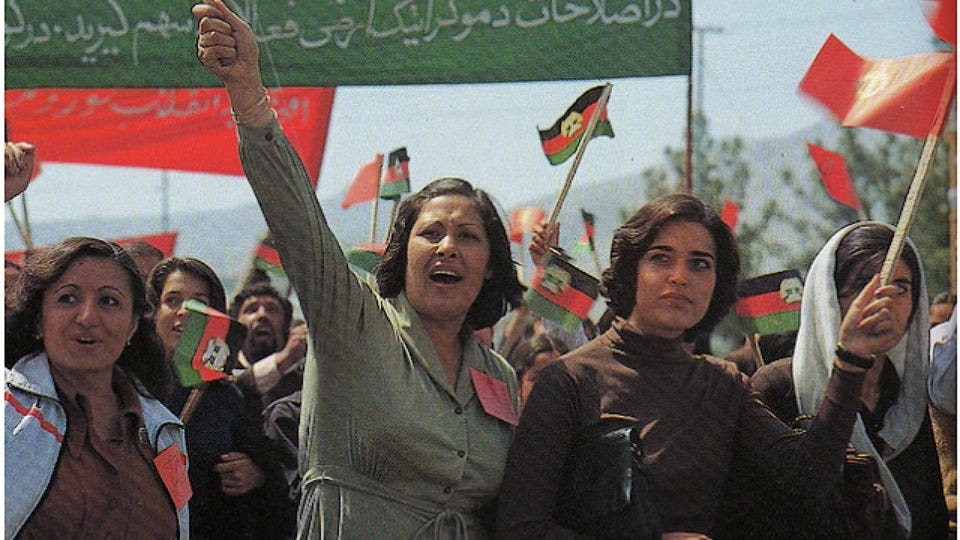
The Taraki government legalized labor unions, set up a minimum wage, a progressive income tax, a literacy campaign, programs that gave ordinary people greater access to health care, housing, public sanitation. Peasant cooperatives were started and price reductions on some key foods were imposed. Campaign to emancipate women from tribal bondage. It provided public education for girls and for the children of various tribes. Women studied agriculture, engineering and business at the Kabul’s university. Afghan women held government jobs. Women drove cars, traveled and fifty percent of university students were women. The government also abolished all debts owed by farmers, and began developing a major land reform program.
The feudal landlords opposed the land reform program that infringed on their holdings. And tribesmen and fundamentalist mullahs vehemently opposed the government’s dedication to gender equality and the education of women and children. The government moved to eradicate opium production. Until then—Afghanistan had been producing more than 70 percent of the opium needed for the world’s heroin supply because the CIA launched Operation Cyclone, which would eventually be the downfall of this progressive Afghan government.
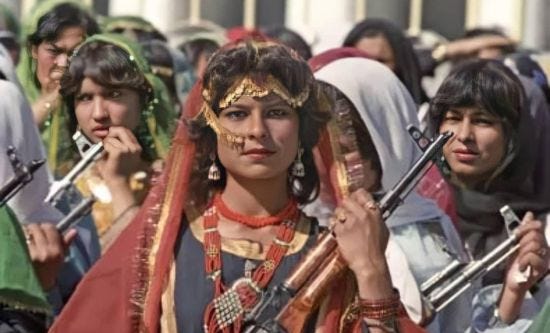
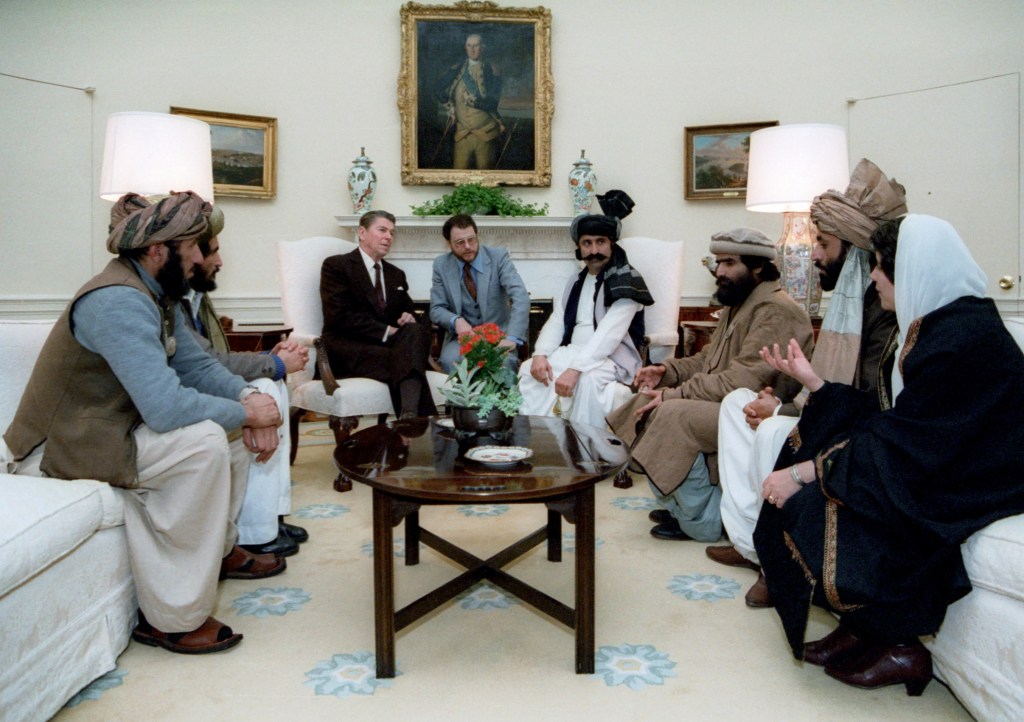
Because of its egalitarian and collectivist economic policies—the Taraki government also incurred the opposition of the US government. Almost immediately after the PDP coalition came to power, the CIA, assisted by Saudi and Pakistani military, launched a large scale intervention into Afghanistan on the side of the ousted feudal lords, reactionary tribal chieftains, mullahs, and opium traffickers.
Rumored CIA asset, Hafizulla Amin, committed a coup against the Taraki government, “He executed Taraki, halted the reforms, and murdered, jailed, or exiled thousands of Taraki supporters as he moved toward establishing a fundamentalist Islamic state. But within two months, he was overthrown by PDP remnants including elements within the military…[US] National security adviser Zbigniew Brzezinski publicly admitted–months before Soviet troops entered the country–that the Carter administration was providing huge sums to Muslim extremists to subvert the reformist government.”
Brzezinksi, “ Yes. According to the official version of history, CIA aid to the Mujahadeen began during 1980, that is to say, after the Soviet army invaded Afghanistan, 24 Dec 1979. But the reality, secretly guarded until now, is completely otherwise: Indeed, it was July 3, 1979 that President Carter signed the first directive for secret aid to the opponents of the pro-Soviet regime in Kabul. And that very day, I wrote a note to the president in which I explained to him that in my opinion this aid was going to induce a Soviet military intervention…It had the effect of drawing the Russians into the Afghan trap and you want me to regret it? The day that the Soviets officially crossed the border, I wrote to President Carter: We now have the opportunity of giving to the USSR its Vietnam war…What is most important to the history of the world? The Taliban or the collapse of the Soviet empire?”
It was only after this, that the Afghan PDP requested Soviet military aid to stop the counter-revolution first lead by Amin and then the reactionary fundamentalist tribal leaders supported by the West and Pakistan.
Mujahideen turned the country into a fundamentalist warlord torn nation. They fell to infighting, terrorizing the civilian population, committing mass murder, rape, and executions. Tribes ordered farmers to plant opium poppy again after it was outlawed under the PDP. The Pakistani ISI, a close partner to the CIA, set up hundreds of heroin laboratories in Afghanistan-Pakistan border and within 2 years, was the biggest producer of heroin in the world.
In 1995 an extremist sect of Sunni Islam, the Taliban with US and Pakistan funding, gained power in the country through fear and bribery.
Still with all of this going on in 1999, the US government was paying the salary of every single Taliban government official.
It wasn’t until 2000, when the Taliban decided to eradicate opium production, did the US government policy on the Taliban and Afghanistan shifted.
Another key aspect to US policy towards Afghanistan, and the larger middle east region, is oil. After the overthrow of the USSR, Central Asian countries that were rich with oil reserves were now open to western capital accumulation. The US acquired the rights to nearly 75% of the these new reserves. The issue was transporting the oil from countries like Kazakhstan and Turkmenistan. US based oil company, UNOCAL, favored a route crossing Afghanistan and Pakistan. Negotiations were ongoing between UNOCAL and the Taliban government but slowing down due to competing bids from Argentina. The 9/11 attacks and Bush’s policy shift on Afghanistan gave UNOCAL a fast track and monopoly on the oil transportation through the region from Central Asia.
Former professor John Ryan said, “[if Washington had left the Marxist Taraki government alone back in 1979,] there would have been no army of mujahideen, no Soviet intervention, no war that destroyed Afghanistan, no Osama bin Laden, and no September 11 tragedy.”
Last 20 Years a Success for Western Imperialism?
From the invasion in October 7, 2001 to the fall of Kabul by the Taliban resurgence in August 15, 2021—the US and Western goals were clear and could not be stopped. Restart the opium production of the region, guarantee the control and security of oil transportation from Central Asia, and have geopolitical stronghold next to the Pakistan, China, and Iran. The Taliban offering to hand over Osama Bin-Laden to a third-party to deliver him to the US after the 9/11 terrorist attacks were not enough to stop these goals. The West, lead by the US empire, decided to invade.
The shared neoliberal policy of the US-Middle East conflict of the last 20 years was clearly stated on September 19, 2003 by head of the Coalition Provisional Authority, Paul Bremer, “ the full privatization of public enterprises, full ownership rights for foreign firms of Iraqi [and Afghan] US businesses, full repatriation of foreign profits…the opening of banks to foreign control, national treatment for foreign companies and…the elimination of nearly all trade barriers.” (Harvey, 2007a, pp. 22–44)
Organizations such as The World Bank and USAID, a front of the CIA, determined the foreign capital investment and economic restructuring of Afghanistan. As Julian Assange said, “The goal is to use Afghanistan to wash money out of the tax bases of the US and Europe through Afghanistan and back into the hands of a transnational security elite. The goal is an endless war, not a successful war.” The US government spent $300 million each day on the war in Afghanistan. In totality, $2 trillion over 20 years. Yet, the number of Afghans living in poverty rose from 9.1 million in 2007 to 19.3 million in 2016. In stark contrast to the people and their suffering, BBC reported, “Afghan ambassador in Tajikistan says Ashraf Ghani escaped with bags full of 169 million US dollars when Kabul was falling.”
Afghanistan is currently the source of 90% of the world’s illicit opium, and the natural connection to the opioid crises with Big Pharma. It’s the largest narco-state in the world. Over 50% of its national GDP in 2008 was from opium. Colombia at the height of the cocaine industry, only totaled 3% of the national GDP. It was so widespread and accepted that the brother of US puppet president Hamid Karzai—Ahmed Wali—was the largest opium drug kingpin in the south of the country, and he was paid by the CIA. The US military paid “local strongman Gul Agha Sherzai” $10 million to push out his competition in a neighboring province. USAID, public front of the CIA, invested in the irrigation system in the Helmand province which was used to directly mass produce opium. “Between 2005 and 2015, the number of adult drug users jumped from 900,000 to 2.4 million, according to the United Nations, which estimates that almost one in three households are directly affected by addiction.”
In the past decade, worldwide deaths related to opioids has risen by 71%. In the US alone 841,000 Americans have died from opioid overdose since the war began. These connections can not be ignored.
Decades ago, the US and CIA helped fund its war against the Sandinistas in Nicaragua through crack cocaine sales in black neighborhoods across the US—linking far-right death squads (Contras), US government, and drug kingpins in Latin America. The same playbook can be seen here. The opium trade is directly funding the US dirty wars of today. Colonel Lawrence Wilkerson said to the Ron Paul Institute, “We are in Afghanistan…it has nothing to do with Kabul and state building. Nothing to do with fighting the Taliban…nothing to do with fighting any terrorist group. It has everything to do with three primary objectives…first objective is to be in the place…proximate to the central base road initiative of China that runs along central Asia. If we had to impact that with military power we are in position in Afghanistan. Second reason we are there is because we are [very close] with potentially the most unstable nuclear stockpile on the face of the earth, in Pakistan. We want to be able to leap on that…and the third reason we are there—is because there’s 20 million Uighurs, and they don’t like Han Chinese in Xinjiang province in western China…and if the CIA have to mount an operation using those Uighurs as [Turkish president] Erdoğan done in Turkey…the CIA will destabilize China and that would be the best way to do it. Foment unrest…” The State Council Information Office of the People’s Republic of China in March 2019 reported that from 1990 to 2016 “thousands” of terrorist attacks were carried out in Xinjiang province from radical islamic extremists getting training in neighboring countries like Afghanistan. Abudulrekep Tumniaz, President of Xinjiang Islamic Institute believes the attacks were a “…conspiracy, a planned affair…” The US dirty wars of today in China, Haiti, Colombia, Bolivia, Cuba, Nicaragua, Mexico and Venezuela are funded by the opium production of Afghanistan and drug trafficking to major cartels.
The US withdrawal from Afghanistan is also largely overstated. As Jacobin writer Branko Marcetic wrote, “Maybe more ominously, Biden also cited something else to justify ending the war: the need to take on China. Along with the fact that China hawk Tony Blinken was reportedly the driving force behind the decision to get out of Afghanistan…” But as Colonel Wilkerson admitted, the primary goals of US occupation of Afghanistan is to wage covert war against China and potentially hit China’s economic infrastructure plans in Central Asia. In May 12, 2021—it was reported by NY Magazine, “Contractors are a force both the U.S. and Afghan governments have become reliant on, and contracts in the country are big business for the U.S. Since 2002, the Pentagon has spent $107.9 billion on contracted services in Afghanistan, according to a Bloomberg Government analysis. The Department of Defense currently employs more than 16,000 contractors in Afghanistan, of whom 6,147 are U.S. citizens — more than double the remaining U.S. troops.” In July it was reported by US News, “New documents prepared for Congress by the Defense Department show the total number of all kinds of contractors in Afghanistan has dropped by more than half in the last three months from almost 17,000 as of April to only 7,800 this month, with fewer than 2,700 Americans among them.” And August 14, in the midst of the fall of Kabul to Taliban, President Biden ordered 1,000 more troops—not private contractors—to aid in the evacuation of Americans.
The reality is, the US is not planning on leaving Afghanistan, a country with too much resources and too much geopolitical importance. While the type or intensity of US intervention in Afghanistan may shift, the US is already manufacturing consent for continued occupation. CNN reported August 18th, that “the Taliban are sitting on $1 trillion worth of minerals the world desperately needs…It’s also causing security experts to wonder: What’s going to happen to the country’s vast untapped mineral wealth?” That resource is largely lithium—the main resource for electric vehicles. Afghanistan’s reserve of lithium may be the largest deposits of lithium in the world. The US government and capitalist class admittedly committed a coup against socialist lead Bolivia in 2019 for the purpose of gaining access to their lithium deposits. What makes people think the US would leave $1 trillion in natural resources behind in a country it can undermine and control still?
The Taliban outlasted the height of the US war effort and regained Afghanistan from a faction of the Northern Alliance—which is now waging a resistance to the Taliban, lead by the son of anti-communist Mujahideen leader Ahmad Shah Massoud. Both sides of this conflict have deep connections to the US and Pakistan governments through the CIA and ISI—with the Taliban stating they are working with the US on the withdrawal process—so what’s next for Afghanistan? Most likely more factional infighting between fundamentalist groups with the US attempting to play puppet master still to steal more valuable resources and sap the labor power of the working people from the “graveyard of empires.”
Sources:
Parenti, M. (2021, May 4). Afghanistan, Another Untold Story. Common Dreams. https://www.commondreams.org/views/2008/12/02/afghanistan-another-untold-story
Bechtel, M. (2021, April 16). Afghanistan’s socialist years: The promising future killed off by U.S. imperialism. People’s World. https://www.peoplesworld.org/article/afghanistans-socialist-years-the-promising-future-killed-off-by-u-s-imperialism/
MacLeod, A. (2021, July 12). Revealed: How the CIA Turned Afghanistan into a Failed Narco-State. MintPress News. https://www.mintpressnews.com/cia-afghanistan-drug-trade-opium/277780/
Cockburn, A. C. S. J.-. (1998, January 15). How Jimmy Carter and I Started the Mujahideen. CounterPunch.Org. https://www.counterpunch.org/1998/01/15/how-jimmy-carter-and-i-started-the-mujahideen/
Bush rejects Taliban offer to expel bin Laden. (2001, October 15). The Irish Times. https://www.irishtimes.com/news/bush-rejects-taliban-offer-to-expel-bin-laden-1.332150
Harvey, D. (2007b). A Brief History of Neoliberalism. Oxford University Press.
Harvey, D. (2007a). Neoliberalism as Creative Destruction. The ANNALS of the American Academy of Political and Social Science, 610(1), 21–44.
Helman, C. (2021, August 17). The War In Afghanistan Cost America $300 Million Per Day For 20 Years, With Big Bills Yet To Come. Forbes. https://www.forbes.com/sites/hanktucker/2021/08/16/the-war-in-afghanistan-cost-america-300-million-per-day-for-20-years-with-big-bills-yet-to-come/?sh=5833547e7f8d
Sabga, P. (2021, August 17). The US spent $2 trillion in Afghanistan – and for what? Business and Economy News | Al Jazeera. https://www.aljazeera.com/economy/2021/8/16/the-us-spent-2-trillion-in-afghanistan-and-for-what
Filkins, D., Mazzetti, M., & Risen, J. (2009, October 28). Brother of Afghan Leader Said to Be Paid by C.I.A. The New York Times. https://www.nytimes.com/2009/10/28/world/asia/28intel.html
st. Clair, J. (2020, July 10). “I Could Live With That”: How the CIA Made Afghanistan Safe for the Opium Trade. CounterPunch.Org. https://www.counterpunch.org/2020/07/10/i-could-live-with-that-how-the-cia-made-afghanistan-safe-for-the-opium-trade/
United Nations. (2020, May 25). UNODC World Drug Report 2020: Global drug use rising; while COVID-19 has far reaching impact on global drug markets. United Nations : Office on Drugs and Crime. https://www.unodc.org/unodc/press/releases/2020/June/media-advisory—global-launch-of-the-2020-world-drug-report.html
(2014, May 7). The CIA, Contras, Gangs, and Crack. Institute for Policy Studies. https://ips-dc.org/the_cia_contras_gangs_and_crack/
“What Is The Empire’s Strategy?” – Col Lawrence Wilkerson Speech At RPI Media & War Conference. (2018, August 22). [Video]. YouTube.
Fighting Terrorism in Xinjiang. (2019, December 11). [Video]. YouTube.
Marcetic, B. (2021, April 16). Joe Biden Isn’t Ending the War in Afghanistan. Jacobin. https://jacobinmag.com/2021/04/joe-biden-war-afghanistan-troops-trump-media
Reporter, G. S. (2021, April 12). Secretary of state Blinken hits out at China over Taiwan and Covid. The Guardian. https://www.theguardian.com/world/2021/apr/11/antony-blinken-china-aggression-taiwan
Macias, A. (2021, March 25). Top U.S. diplomat warns China threatens NATO security, calls for joint approach to counter Beijing. CNBC. https://www.cnbc.com/2021/03/24/blinken-says-china-threatens-nato-calls-for-joint-approach-to-counter-beijing.html
Seligman, L., Desiderio, A., Bertrand, N., & Toosi, N. (2021, April 20). How Biden’s team overrode the brass on Afghanistan. POLITICO. https://www.politico.com/news/2021/04/14/pentagon-biden-team-overrode-afghanistan-481556
WikiLeaks [@wikileaks]. (2021, August 18). WikiLeaks on Julian Assange and Afghanistan [Video]. Twitter.
Khamoosh, [@KawoonKhamoosh]. (2021, August 18). Kawoon Khamoosh “Afghan ambassador in Tajikistan says Ashraf Ghani escaped with bags full of 169 million US dollars when Kabul [Tweet]. Twitter.
Billing, L. (2021, May 12). The U.S. Is Leaving Afghanistan? Tell That to the Contractors. Intelligencer. https://nymag.com/intelligencer/2021/05/u-s-contractors-in-afghanistan-are-hiring-amid-withdrawal.html
Shinkman, P. (2021, July 21). Number of Private Contractors in Afghanistan Drops Precipitously as Biden Pushes Withdrawal Plan. US News. https://www.usnews.com/news/world-report/articles/2021-07-21/number-of-private-military-contractors-in-afghanistan-drops-precipitously-as-biden-pushes-withdrawal-plan
Biden orders 1,000 more troops to aid Afghanistan departure. (2021, August 15). AP NEWS. https://apnews.com/article/lifestyle-joe-biden-middle-east-evacuations-kabul-8ec855b3f943dafe80d3d3ca6b0953f2
Julia Horowitz, CNN Business. (2021, August 19). The Taliban are sitting on $1 trillion worth of minerals the world desperately needs. CNN. https://edition.cnn.com/2021/08/18/business/afghanistan-lithium-rare-earths-mining/index.html
(2020, July 25). Elon Musk Confesses to Lithium Coup in Bolivia. News | TeleSUR English. https://www.telesurenglish.net/news/elon-musk-confesses-to-lithium-coup-in-bolivia-20200725-0010.html
TeleSur. (2019, December 17). “Fascists, Racists Plotted the Lithium Coup in Bolivia” Morales. News | TeleSUR English. https://www.telesurenglish.net/news/Fascists-Racists-Plotted-the-Lithium-Coup-in-Bolivia-Morales-20191217-0003.html
TeleSur. (2020, November 10). Evo Morales: Lithium Was the Reason for the Coup in Bolivia. News | TeleSUR English. https://www.telesurenglish.net/news/Morales-Lithium-Was-the-Reason-for-the-Coup-D-Etat-in-Bolivia-20201110-0014.html


Leave a Reply